Securing Your Enterprise Future: Navigating AI's $965 Billion Boom for Peak Productivity
Securing Your Enterprise Future: Navigating AI's $965 Billion Boom for Peak Productivity
As a Senior Tech Writer at Workalizer.com, I’ve witnessed firsthand how rapidly the enterprise landscape is being reshaped by artificial intelligence. The hype is real, the investment is staggering, and the implications — both exhilarating and challenging — are now undeniably mainstream. The question isn't whether AI will transform your business, but how effectively you'll harness its power while safeguarding against its emerging pitfalls.
We stand at an inflection point. Just this week, Anthropic, the AI firm behind the Claude chatbot, announced a mind-boggling $965 billion valuation after a fresh $65 billion funding round. This isn't just a number; it's a thunderclap signaling an unprecedented influx of capital and innovation — a nearly trillion-dollar bet on AI's transformative potential. But what does this mean for HR leaders, engineering managers, and C-Suite executives tasked with driving real, measurable organizational efficiency?
The Unstoppable Surge: AI's Foundational Shift in 2026
The monumental valuation of companies like Anthropic isn't an isolated incident; it's a symptom of a much larger, systemic shift. AI is no longer just a layer on top of existing technology; it's becoming the very foundation. Consider the enormous investments in underlying infrastructure:
- Next-Gen Chip Manufacturing: Just yesterday, Intel and 3D Glass Solutions committed $3.3 billion to build a glass-substrate plant in India. This facility, targeting 70,000 glass substrates annually, is critical for the “advanced packaging” of future chips — the very engines that power sophisticated AI models. It demonstrates a global race to build the physical bedrock for the AI future.
- Ubiquitous Sensing and Connectivity: The lines between communication and sensing are blurring. Samsung and LG Uplus announced a collaboration to turn ordinary cell towers into radar systems for 6G. This “Integrated Sensing and Communication” (ISAC) technology means future networks won't just carry data; they'll also perceive and understand their environment, creating a hyper-aware operational ecosystem.
These developments underscore a future where AI isn't an “add-on” but an intrinsic part of every system, every process. This rapid evolution promises unprecedented efficiency, but it also introduces new complexities. To truly “unlock unprecedented efficiency” in this environment, enterprises must move beyond superficial AI adoption and embrace a strategic, data-driven approach. For more on this, you might find our recent post, Unlock Unprecedented Efficiency: How AI's Rapid Evolution Reshapes Your Enterprise in 2026, particularly insightful.
AI's Double-Edged Sword: Efficiency Gains vs. Operational Strain
While the promise of AI-driven efficiency is immense, we cannot ignore its immediate, tangible challenges. AI, particularly generative AI, is lowering the barrier to entry for many tasks, but this isn't always a net positive for organizational efficiency.
Consider the recent — and frankly, alarming — report from Australia. The Fair Work Commission, their workplace tribunal, has seen an estimated 70% workload increase over the past three years, partly blaming generative AI tools. Between July 2025 and April 2026 alone, the commission received 44,039 lodgments. Why? Because AI makes it “easy to produce polished-sounding but often generic content.” This means more people are filing more complex, and sometimes inaccurate, claims, overwhelming the system.
This “AI paradox” — where technological advancement can inadvertently create new bottlenecks and anxieties — is a critical concern for every leader. It highlights that while AI can amplify human output, it also amplifies the need for robust processes, clear governance, and unbiased oversight. It also fuels “workforce anxiety,” a topic we explored in depth in The AI Paradox of 2026: Why Profit Surges Are Fueling Workforce Anxiety.
Navigating the AI Paradox: The Imperative for Data-Driven Insights
The Australian case study isn't an anomaly; it's a stark warning. As AI becomes more integrated into our daily workflows — from drafting emails to generating reports — the need for clear, unbiased productivity insights becomes paramount. Simply “doing more” doesn't equate to “achieving more.” In fact, it can lead to burnout, inefficiency, and a dilution of genuine impact.
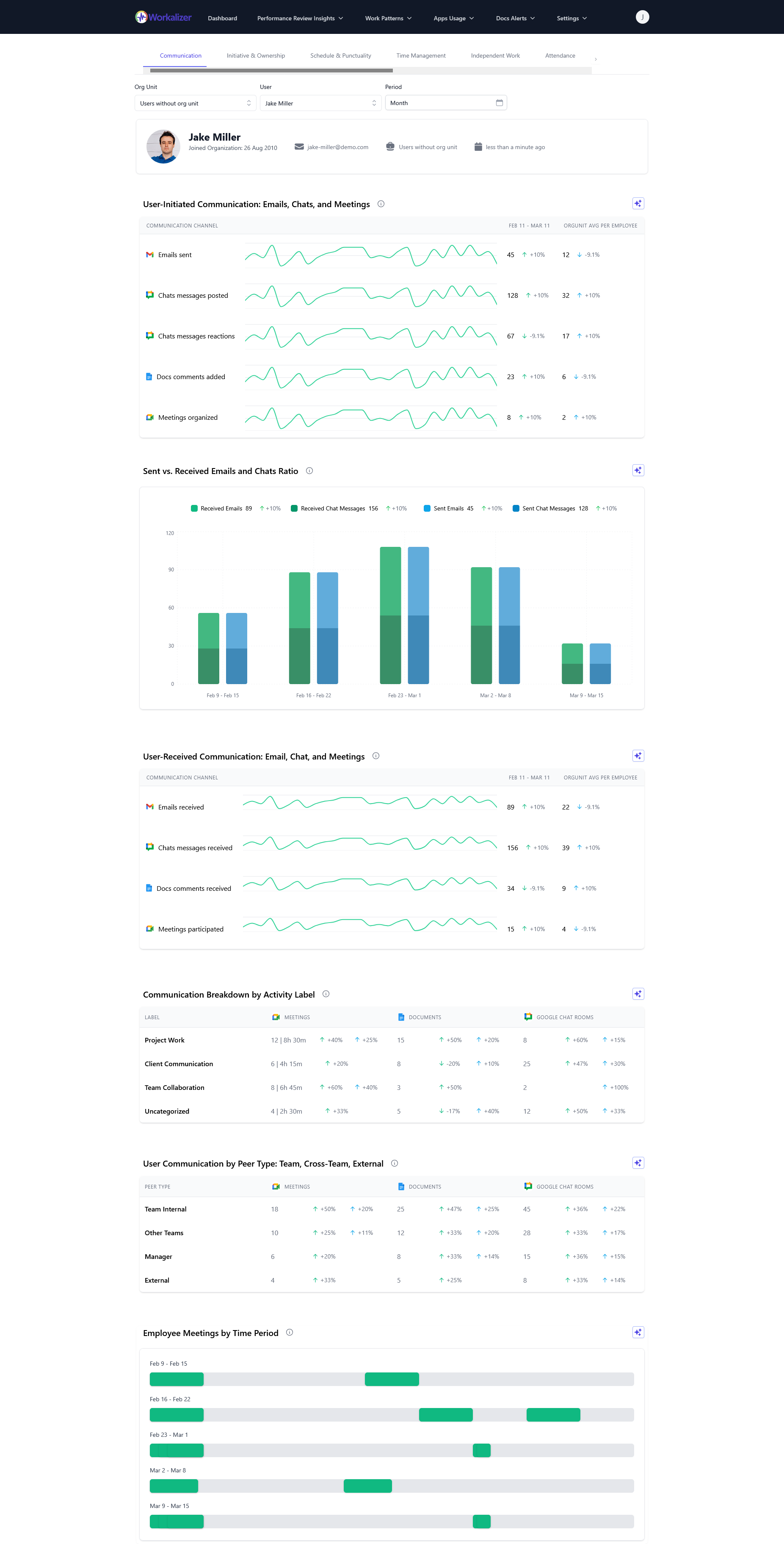
This is where Workalizer.com steps in. We provide AI-powered performance review insights based on your company’s actual usage of Google Workspace. By analyzing signals from Gmail, Drive, Chat, Gemini, and Meet, we offer data-driven, unbiased productivity analytics that cut through the noise. We answer critical questions like:
- Are your teams truly collaborating effectively, or just generating more digital “noise”?
- Where are the real bottlenecks emerging in AI-augmented workflows?
- How can you ensure that the data being created and shared — especially when using tools like Google Drive — is not only contributing to productivity but also adheres to security and compliance standards?
In an era where AI can quickly generate and disseminate information, understanding “is Google Drive a secure way to share files” and “how to share files securely with Google Drive” becomes more critical than ever. The sheer volume of AI-generated content and data means that robust data governance and secure sharing practices are no longer just IT concerns; they are fundamental to maintaining organizational integrity and efficiency. Workalizer helps you see where these practices are being effectively implemented and where there might be gaps, ensuring your AI-driven productivity doesn't come at the cost of security or quality.
Optimizing Your Enterprise for the AI-Augmented Future
The goal isn't to shy away from AI, but to embrace it with eyes wide open, armed with data. Here’s how Workalizer helps leaders optimize their enterprise:
- Identify True Productivity: Distinguish between activity and impact. Our analytics reveal where AI is genuinely enhancing output and where it might be creating superficial busywork.
- Uncover Workflow Bottlenecks: Pinpoint areas where AI integration might be creating unforeseen friction or overwhelming teams, allowing for targeted interventions.
- Foster Accountable Innovation: Encourage experimentation with AI tools while maintaining visibility into their — and your teams’ — performance.
- Mitigate “AI Overload”: Use insights to manage workload, prevent burnout, and ensure that AI empowers, rather than overwhelms, your workforce.
The $965 billion pouring into AI is a testament to its potential. It promises a future of unprecedented efficiency, innovation, and growth. However, realizing this promise requires more than just adopting new tools; it demands a deep understanding of their impact on your people and processes. It demands unbiased, data-driven insights.
Conclusion: Leading with Data in the AI Gold Rush
As we navigate 2026 and beyond, the companies that thrive will be those that not only invest in AI but also intelligently manage its integration. They will be the ones that leverage platforms like Workalizer to gain a clear, objective view of how AI is truly affecting productivity, collaboration, and the overall health of their organization. Don't just ride the AI wave; steer your enterprise through it with precision, purpose, and unparalleled insight.