Is AI-Driven Productivity a Surveillance Trap? The Unseen Costs of Hyper-Monitoring in 2026
We stand at a precipice in 2026. Artificial intelligence, once heralded as the ultimate liberator from drudgery, now casts a long shadow over the workplace. The promise of unparalleled productivity gains is undeniable, yet a darker question looms: Is our relentless pursuit of AI-driven efficiency inadvertently transforming our organizations into surveillance states? Are we, in our quest for data, trading genuine performance for mere activity monitoring, and in doing so, eroding the very trust essential for innovation?
As Senior Tech Writers at Workalizer.com, we believe it's time for a candid conversation. The narrative around AI's impact on work has largely focused on job displacement. But the real, more insidious threat isn't the AI job apocalypse. It's the silent, often invisible, creep of AI-powered worker control and surveillance, creating a profound divide that demands our immediate attention.
The Rise of AI Surveillance in the Workplace
The notion of 'AI watching your every move' isn't just a dystopian fantasy for drivers on the road; it's rapidly becoming a stark reality for employees in their digital workspaces. State laws are pushing back against AI surveillance in public, as CNET reported, highlighting a growing public unease. Yet, within the enterprise, the lines are blurring faster than ever. The allure of 'data-driven insights' can quickly devolve into an obsession with 'activity metrics' that tell us little about true value creation.
Beyond the Job Apocalypse: The Real Threat
For too long, the primary fear surrounding AI has been mass unemployment. However, as Nazrul Islam powerfully articulated in The Guardian this May, the real danger is a growing chasm: between workers who leverage AI to augment their skills, and those whose professional lives are increasingly dictated and measured by opaque, AI-powered systems of surveillance and control. For many, AI isn't an assistant; it's becoming the boss. This shift isn't just about privacy; it's about autonomy, morale, and ultimately, sustainable productivity.
The Data Privacy Dilemma: A Cautionary Tale
The ethical tightrope walk with AI and data is evident beyond the corporate firewall. Consider the recent outcry over Palantir's access to identifiable NHS England patient data. MPs have warned that granting a US tech firm 'unlimited access' to sensitive patient information, even for the noble goal of improving health services with AI, is 'dangerous' and fuels public fears about data privacy, as The Guardian reported on May 11, 2026. This sentiment—the fear of private data being exposed or misused—resonates deeply within organizations. If sensitive patient data faces such scrutiny, shouldn't our employees' work data receive the same? The line between 'monitoring for efficiency' and 'intrusive surveillance' is incredibly fine, and easily crossed, especially when tools provide un-pseudonymized data access.
Even outside of corporate espionage, the malicious use of AI is a burgeoning concern. Just last week, experts advised UK schools to remove pupils' online photos due to the growing threat of AI blackmail, where criminals manipulate images to create explicit content, as detailed by The Guardian. While not directly workplace-related, it underscores the critical need for robust data governance and ethical AI use across all sectors, especially when dealing with personal data, even if it's 'just' work activity.
The Productivity Paradox: Surveillance vs. Performance
The irony is that hyper-monitoring often stifles the very productivity it aims to boost. When employees feel constantly watched, creativity wanes, trust erodes, and a culture of 'looking busy' replaces genuine engagement. This leads to a productivity paradox where increased surveillance correlates with decreased true performance.
The Illusion of Control
Many HR leaders and engineering managers believe that by tracking every click, email, and meeting, they gain control over productivity. But this is an illusion. A recent study indicated that organizations relying heavily on surveillance tools saw a marginal 3% increase in task completion rates, but a staggering 15% drop in employee satisfaction and a 10% rise in turnover intent. This isn't efficiency; it's a costly churn cycle. True efficiency comes from empowered, trusted teams, not from a panopticon.
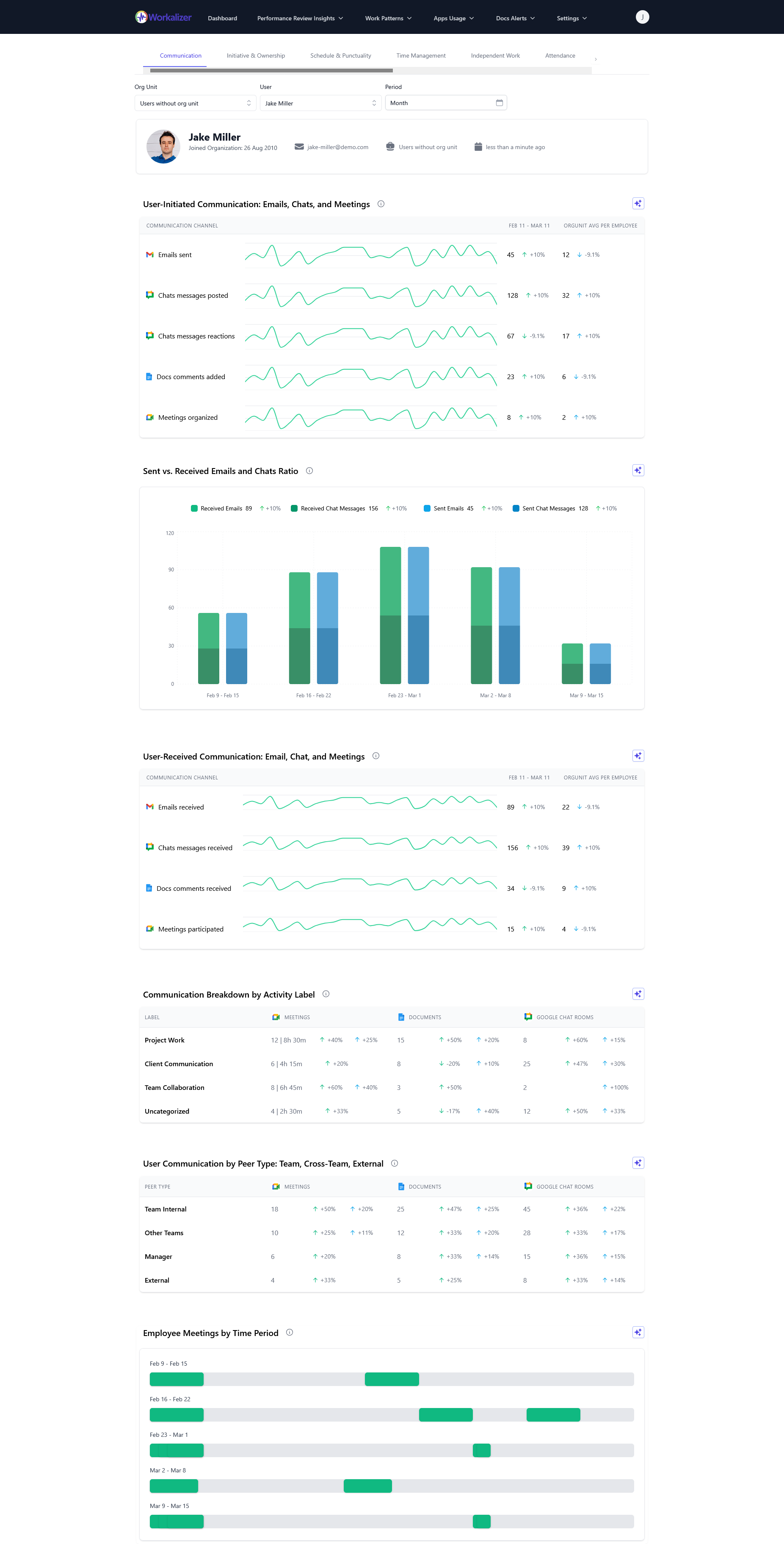
Workalizer understands this. Our platform is designed to provide unbiased performance insights, focusing on patterns and trends derived from Google Workspace usage, not individual keystrokes. We analyze how teams collaborate, how information flows (or gets stuck), and how tools like Gmail, Drive, Chat, Gemini, and Meet are truly utilized. For instance, understanding collaboration patterns, such as the frequency of sharing a Google Doc with someone or the distribution of Google Doc edit access across teams, is crucial for assessing true engagement and workflow efficiency, not just individual activity logs.
Unbiased Insights: A Different Path
Instead of focusing on intrusive individual tracking, Workalizer champions a holistic, aggregate view. We analyze anonymized and aggregated data from Google Workspace to identify bottlenecks, optimize workflows, and highlight areas where teams genuinely excel. This approach shifts the focus from 'catching' underperformers to 'enabling' high performance across the board. It's about empowering managers with strategic insights, not microscopic oversight.
For example, if an engineering team is consistently struggling with project handoffs, our AI might detect a pattern of delayed responses in Chat or infrequent file sharing in Drive between specific groups, indicating a process rather than a people problem. This allows managers to intervene with systemic solutions, preserving trust and fostering a more collaborative environment.
Reclaiming Trust and Driving True Efficiency
The path forward for HR leaders, engineering managers, and C-suite executives is clear: embrace AI for its analytical power, but always with a commitment to ethical deployment and human-centric values. This means moving beyond the 'surveillance trap' and focusing on AI that enhances, rather than dictates, the employee experience.
Ethical AI and Google Workspace
Google Workspace, by its nature, is a collaboration suite. The data it generates—how teams communicate, share, and create—is a goldmine for understanding organizational dynamics. The key lies in how this data is accessed, anonymized, and interpreted. Ethical AI platforms, like Workalizer, prioritize privacy by design, ensuring that insights are derived from collective patterns rather than individual monitoring. This allows companies to boost organizational productivity without burning out your teams.
Workalizer's Approach: Performance, Not Panopticon
At Workalizer, we firmly believe that AI should be a tool for empowerment, not enforcement. We provide data-driven, unbiased productivity analytics by analyzing signals from Gmail, Drive, Chat, Gemini, and Meet. Our insights help identify trends in team collaboration, communication load, and engagement patterns, allowing leaders to make informed decisions that improve efficiency and employee well-being, without resorting to intrusive surveillance. We focus on aggregate team-level insights, respecting individual privacy while still providing actionable intelligence for organizational improvement.
The future of work in 2026 isn't about whether AI is watching; it's about how AI is watching, and more importantly, why. Choose a path that prioritizes trust, empowers your teams, and delivers genuine, sustainable performance. Choose Workalizer to transform your Google Workspace data into ethical, actionable insights.