How to Boost Organizational Productivity Without Burning Out Your Teams: Leveraging AI for True Performance
As a Senior Tech Writer at Workalizer.com, I’ve seen firsthand the relentless pursuit of “more productivity” in the enterprise. Yet, despite countless tools and methodologies, many organizations find themselves trapped in a cycle of “busywork” that paradoxically leads to burnout, not breakthrough. It’s May 2026, and the conversation around performance needs a radical shift. We need to move beyond individual hacks and address the systemic issues that prevent true organizational productivity — and AI is the key.
The truth is, “overwhelm” isn’t merely a personal failing; it’s often a symptom of an environment that’s over-capacity, not just in terms of workload, but in mental and emotional bandwidth. As Megan Hyatt Miller astutely observed in February of this year, the “capacity issue” we face isn’t always about doing more, but “being” — the burden of navigating constant change and complexity. This resonates deeply with the challenges HR leaders and C-suite executives are grappling with today: how do you foster high performance when your teams are stretched thin?
The Myth of More: Why Traditional Productivity Hacks Fall Short
For years, the advice has been clear: “ignore your preferences,” “think there&rsquos time for everything,” or “don’t know which activities really matter.” These are indeed “7 Biggest Reasons You Aren’t Productive” at an individual level (as highlighted in a December 2024 analysis). We’ve all tried — defining success, dumping distractions — to “stop procrastinating and start being productive.” And while these personal strategies are valuable, they often fail to move the needle at scale.
Why? Because enterprise-level performance isn't just a sum of individual efforts. It's about the collective system, the interactions, the tools, and the overarching strategic alignment. When an organization is experiencing widespread overwhelm, it’s not about individual employees needing more “grit”; it’s about the system failing them. The sheer cognitive load of modern work, exacerbated by a “always-on” culture, drains the very mental and emotional bandwidth needed for deep work and innovation. Without addressing this systemic issue, simply telling employees to “be more productive” is akin to asking a car with a flat tire to drive faster. It ignores the fundamental environmental — and often invisible — constraints.
**
Beyond Busywork: Identifying What Truly Matters for Performance
One of the most insidious productivity traps is mistaking activity for achievement. “In any career, goal, project, or challenge there will be magic activities that accelerate your progress, and without which you can’t…” move forward, according to Get Organized Wizard. But how do you identify these “magic activities” across hundreds or thousands of employees? How do you ensure that your teams aren't spending valuable time figuring out how to edit a shared Google Doc when they should be focused on strategic content creation?
This is where Key Performance Indicators (KPIs) become indispensable. As UpRaise.io emphasizes, “you can’t just rely on guesswork – you need measurable data that tells you whether you’re moving in the right direction.” (UpRaise.io, updated February 2026). However, choosing the “right” KPIs is a challenge in itself. Many organizations struggle with a significant “gap between strategy and execution,” failing to “cascade goals and organizational alignment” effectively (Performance Magazine, April 2026). This disconnect means employees often work diligently, but not necessarily on tasks that align with the company’s highest priorities. The result? High effort, low impact, and ultimately, a disillusioned workforce.
The Workalizer Advantage: Unbiased Data for Unprecedented Clarity
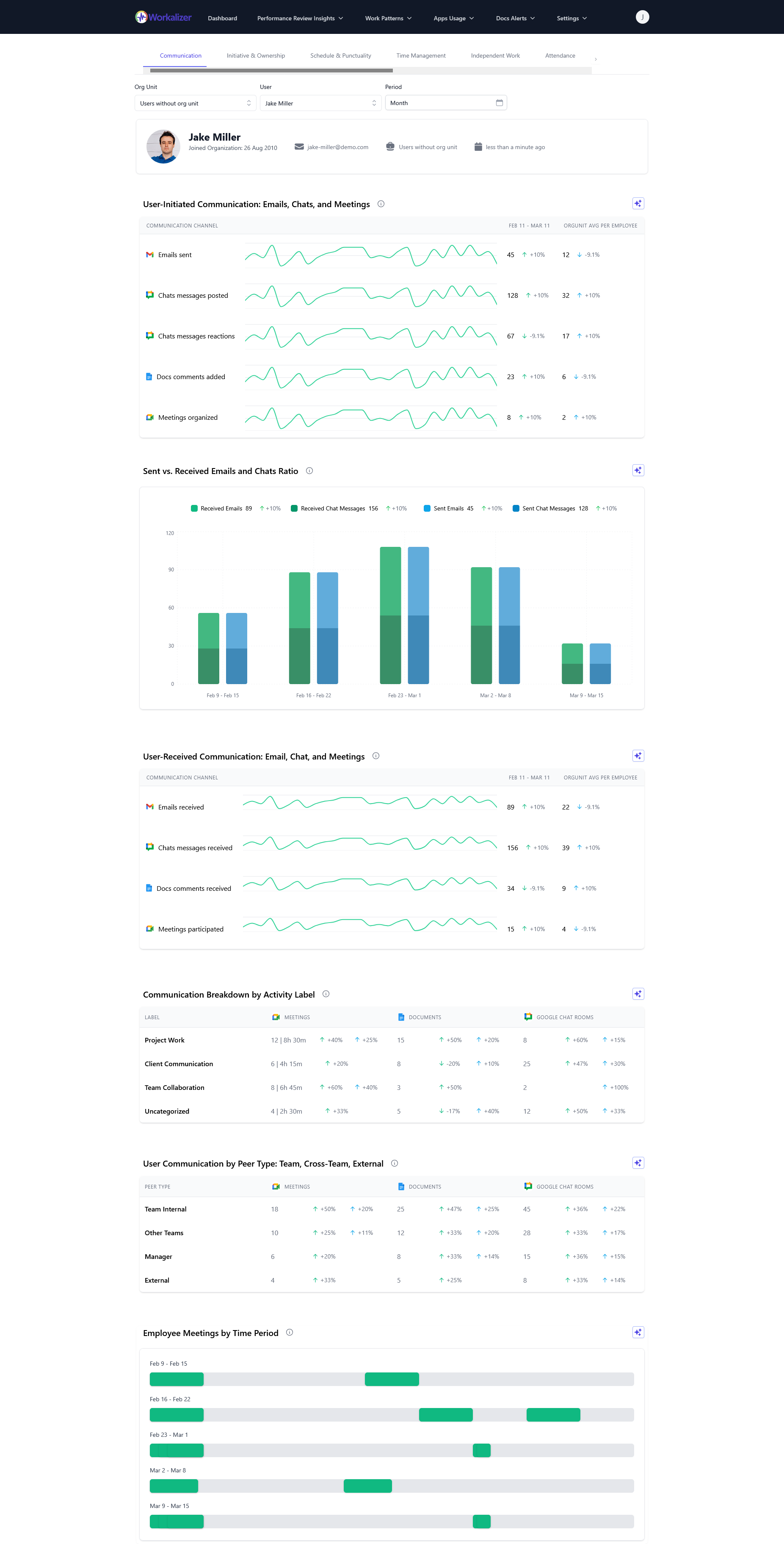
This is precisely where Workalizer steps in, redefining how organizations approach performance and productivity. We are an AI-powered platform that transforms raw activity within Google Workspace — from Gmail, Drive, Chat, Gemini, and Meet — into data-driven, unbiased productivity analytics. Imagine having the clarity to see not just who is doing what, but how those actions contribute to strategic objectives.
Our AI analyzes these signals to provide insights that go far beyond surface-level metrics. We help HR leaders and managers understand patterns of collaboration, communication efficiency, and focus — identifying bottlenecks and opportunities for optimization that are invisible to the naked eye. This data empowers leaders to “define success” with precision and “dump distractions” by strategically reallocating resources and refining workflows. It’s about creating an environment where employees can truly focus on the “magic activities” that drive progress, rather than getting bogged down by inefficiencies.
For a deeper dive into how this works, read our recent post: Boost Productivity & Cut Waste: How AI Unlocks Unbiased Performance Insights in 2026.
Beyond just activity, Workalizer helps ensure that critical information, often stored in a Google Drive secure file, is being accessed and utilized appropriately. This insight not only enhances productivity by highlighting efficient information flow but also strengthens data governance and security practices, offering a holistic view of workspace engagement.
****
From Overwhelm to Organizational Alignment: A Strategic Imperative for 2026
By providing objective data, Workalizer helps leaders address the “overwhelm” not by demanding more from individuals, but by optimizing the organizational environment itself. When you can see, with data, where time is truly spent, where collaboration thrives, and where communication breaks down, you can make informed decisions that reduce friction and enhance capacity.
This data-driven approach is critical for achieving true “organizational alignment.” It allows C-suite executives to understand if their strategic goals are genuinely being translated into daily actions across all teams. It enables engineering managers to identify if their developers are spending adequate time on coding vs. administrative tasks. It helps HR leaders craft targeted interventions, training programs, or process improvements based on real usage patterns, not just anecdotal evidence.
In an era where “enterprise AI strategy” is paramount, specialized tools like Workalizer prove their worth by delivering actionable insights that generic solutions can’t. If you’re questioning whether your current AI investments are truly moving the needle, consider this: Is Your Enterprise AI Strategy Missing the Point? Why Specialized Tools Still Reign in 2026.
The Future of Work is Measured, Not Guessed
The days of relying on intuition or “gut feelings” for performance management are rapidly fading. In 2026, the competitive edge belongs to organizations that embrace data to understand their workforce and optimize their operational environment. Workalizer is at the forefront of this transformation, offering a powerful, unbiased lens into your Google Workspace ecosystem.
Don’t let overwhelm define your organization’s potential. Leverage AI to unlock unparalleled insights, foster a truly productive environment, and drive strategic alignment without pushing your teams to the brink of burnout. The future of organizational productivity isn’t about working harder; it’s about working smarter, with clarity and purpose, guided by the undeniable truth of data.