AI's Billion-Dollar Bet: 3 Strategic Imperatives for HR & Tech Leaders in 2026
The year 2026 has dawned with a clear, resounding message for enterprise leaders: AI isn't just a tool; it's a fundamental shift, reshaping the very bedrock of our organizations. As a Senior Tech Writer at Workalizer.com, I've witnessed firsthand the accelerating pace of this transformation. We're past the theoretical debates; we're in the thick of a multi-billion-dollar re-architecture of the global workforce. This isn't about incremental efficiency gains; it's about a strategic reckoning that demands immediate attention from HR leaders, Engineering Managers, and C-Suite executives alike.
The signals are unambiguous. Just yesterday, May 18, 2026, Meta announced it was cutting approximately 8,000 jobs, alongside cancelling 6,000 open requisitions. This isn't a cost-cutting measure born from struggle; it's a calculated reinvestment. Meta reported record first-quarter 2026 revenue of $56.31 billion and full-year 2025 revenue of $201 billion. Their move signifies a profound belief that the return on AI infrastructure now decisively exceeds the return on human labor. Mark Zuckerberg's bold bet involves raising 2026 capital expenditure guidance to an astonishing $125 billion to $145 billion, primarily directed at data centers, Nvidia GPUs, and custom silicon to power their Llama model ecosystem. This seismic shift demands that every forward-thinking organization re-evaluate its strategic priorities.
Here are three strategic imperatives that HR and tech leaders must embrace in 2026 to thrive amidst this AI-driven transformation.
1. The Unprecedented Scale of AI Investment vs. Workforce Restructuring
The staggering figures from Meta provide a stark benchmark for the year 2026. A company with record revenues is actively shedding thousands of jobs to funnel an unprecedented $145 billion into AI infrastructure. This isn't merely automation; it's a systematic conversion of human capital into algorithmic power. For HR and tech leaders, this trend necessitates a radical re-evaluation of workforce planning, talent acquisition, and employee development strategies. The question is no longer if AI will impact your workforce, but how deeply and how quickly. Organizations that fail to anticipate this shift risk being outmaneuvered by competitors who are aggressively investing in AI-driven operational models. This means a renewed focus on reskilling and upskilling programs to equip existing employees with the capabilities to manage, leverage, and innovate with AI, rather than be replaced by it.
The Cost of Autonomous Intelligence
While the promise of AI-driven efficiency is immense, the operational costs of running autonomous AI at scale are equally significant. Consider the case of Peter Steinberger, creator of OpenClaw. His project, utilizing 100 OpenAI Codex instances, racked up an eye-watering $1.3 million in OpenAI API tokens in a single month. This bill, covered by OpenAI as a research investment, translates to 603 billion tokens across 7.6 million requests. These AI agents weren't just writing code; they were performing complex tasks like reviewing pull requests, scanning for security vulnerabilities, deduplicating GitHub issues, writing fixes, and opening new pull requests. This demonstrates the immense potential for AI to automate entire engineering workflows, but it also highlights the substantial financial commitment required to deploy AI agents continuously at scale. Understanding these economics is crucial for budgeting and demonstrating ROI on AI initiatives.
2. Pervasive AI Integration: From Personal Assistants to Enterprise Workflows
AI is no longer confined to specialized labs or niche applications; it's rapidly becoming the invisible engine powering our daily digital lives. The announcements from Google I/O 2026, heavily featuring Gemini intelligence and broader AI integration into Android 17, underscore Google's commitment to embedding AI at every touchpoint. Even competitors like Apple are rumored to be leaning heavily on Google's AI for their next-gen Siri app, further solidifying Gemini's role as a foundational AI layer. Beyond personal devices, we're seeing AI generate entire content streams, as evidenced by Amazon's new Alexa Podcasts feature, which creates full podcast episodes on demand from licensed journalism.
Redefining Collaboration in Google Workspace
For organizations heavily reliant on Google Workspace, this pervasive AI integration is a game-changer. Gemini's capabilities are transforming how teams interact with Gmail, Drive, Chat, and Meet. Tasks that once required manual effort are now being augmented or entirely automated by AI, from drafting emails to summarizing meetings and even assisting with complex data analysis within Sheets. This fundamentally alters the dynamics of Google Workspace productivity. The way teams approach "google docs collaboration" is evolving, with AI suggesting edits, improving writing, and even generating content. Similarly, the process to "share files on drive" becomes more intelligent, with AI recommending recipients or access levels based on context. Workalizer is at the forefront of understanding these new dynamics, providing unbiased insights into how your teams are truly leveraging these powerful new tools.
3. The Imperative for Data-Driven Performance Management in the AI Era
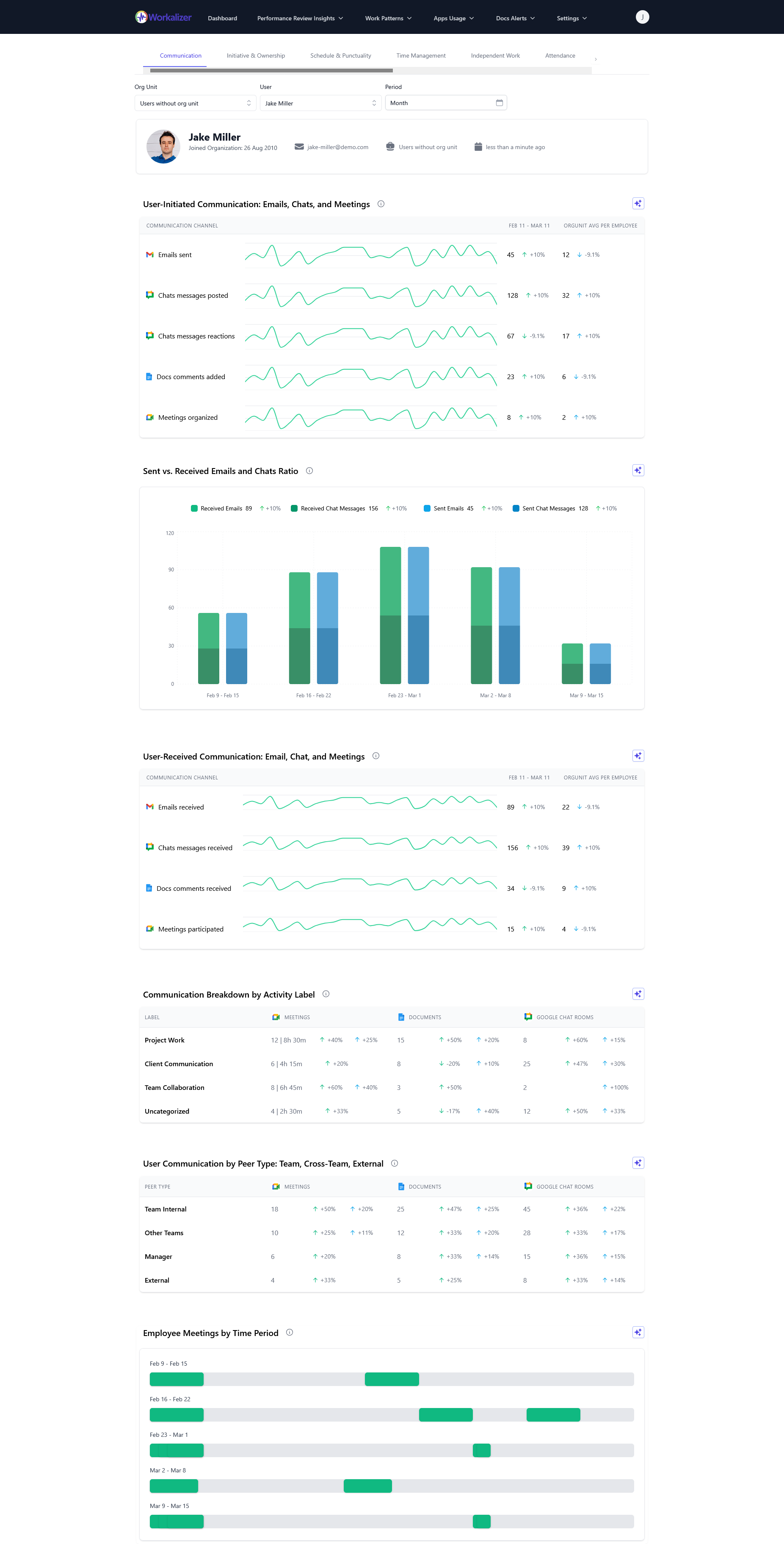
As AI takes on increasingly complex tasks, from coding to content generation, the traditional metrics for measuring human performance become insufficient, if not obsolete. When AI agents are autonomously performing tasks that once required a team of engineers, how do you accurately assess the productivity and impact of your human workforce? The answer lies in moving beyond subjective assessments and embracing robust, data-driven performance analytics. This is where Workalizer shines. By analyzing real-time signals from your Google Workspace usage – Gmail, Drive, Chat, Gemini, and Meet – we provide unbiased, actionable insights into how your teams are actually working, collaborating, and leveraging AI. This is critical for understanding the true ROI of your AI investments and ensuring that your human capital is deployed effectively.
Beyond Traditional Metrics
The shift towards AI-augmented work demands new key performance indicators (KPIs). It's no longer just about individual output, but about the synergy between human intelligence and artificial intelligence. How effectively are employees prompting Gemini? Are they leveraging AI-powered summaries in Meet to save time? Are they maximizing the intelligent suggestions in Google Docs? These are the questions that Workalizer helps answer, providing a clear picture of enterprise efficiency and helping leaders make informed decisions. This proactive approach to performance management is essential for boosting enterprise performance in an environment defined by rapid technological evolution. Without this data, leaders are navigating blind, risking both under-utilization of expensive AI tools and misalignment of human talent.
Conclusion
The year 2026 represents a watershed moment in the enterprise AI journey. From Meta's colossal investment and workforce restructuring to the pervasive integration of Gemini across platforms and the high costs of autonomous agents, the landscape is undeniably transforming. For HR leaders, Engineering Managers, and C-Suite executives, the strategic imperatives are clear: understand the economics of AI deployment, adapt to its pervasive integration into daily workflows, and implement data-driven performance management systems that can accurately measure impact in this new era. Workalizer is your essential partner in this journey, providing the unbiased, data-driven insights you need to navigate these shifts, optimize your Google Workspace usage, and unlock peak organizational efficiency in the age of AI.