Beyond the HRIS-ITSM Divide: Optimizing Employee Lifecycle with a Connected https workspace google com u 0 dashboard
In the fast-paced world of modern work, efficiency is king. Yet, many organizations grapple with a fundamental disconnect that quietly sabotages productivity, security, and the employee experience: the chasm between HR Information Systems (HRIS) and IT Service Management (ITSM) platforms.
As one Reddit user recently highlighted, the reality for many is far from seamless. While systems like HiBob for HR and a separate IT ticketing system might be “integrated” in theory, the practical experience often boils down to occasional field syncing and a lot of manual cross-referencing by IT. This isn't just a minor inconvenience; it’s a systemic flaw that impacts everything from new hire provisioning to critical offboarding security.
The “Integration Illusion”: When Data Lives in Silos
Imagine this scenario, echoed by countless People Ops and IT teams:
- New Hire Onboarding: A new employee starts on Monday. IT doesn't get the memo until Friday, leaving a scramble to provision accounts, hardware, and access. The new hire’s first day is marked by waiting, not working.
- Access Provisioning: An employee requests a Salesforce license (or any other critical tool). IT has no immediate way to verify their role, department, or existing licenses without manually digging through HR records. This delays access and can lead to incorrect provisioning.
- Offboarding Mishaps: An employee’s last day is in two weeks. IT only finds out when they’re tasked with deactivating accounts, often missing crucial time for knowledge transfer, data backup, and ensuring all access is revoked promptly.
These aren't process failures in the traditional sense; the information exists. It's a data synchronization failure. The critical employee data residing in the HRIS isn't effectively surfaced or actioned by the ITSM system, creating bottlenecks and vulnerabilities.
Why a Disconnected HRIS and ITSM is a Problem
The implications of this “integration illusion” are far-reaching:
- Reduced Productivity: Delays in onboarding mean new hires can't contribute immediately. Slow access provisioning hinders existing employees.
- Security Risks: Incomplete offboarding leaves dormant accounts, posing significant security threats and compliance issues. Unnecessary access can also be a vulnerability.
- Poor Employee Experience: Frustration for new hires, existing employees, and departing staff reflects poorly on the organization.
- Wasted Resources: IT spends valuable time on manual data entry and cross-referencing instead of strategic initiatives.
- Data Inaccuracy: Manual processes are prone to human error, leading to incorrect access levels or missed deactivations.
Bridging the Gap: Real Integration Solutions
So, what's the solution? Is it an HRIS fix, an ITSM upgrade, or a dedicated third-party tool? The answer often involves a combination, focusing on robust data flow and automation.
1. API-Driven Integrations
Many modern HRIS and ITSM platforms offer APIs (Application Programming Interfaces) that allow for direct, programmatic data exchange. This is the foundation for true integration, enabling:
- Automated Onboarding: When a new hire is added to the HRIS, their data automatically triggers an IT ticket for account creation, hardware requests, and initial access provisioning.
- Role-Based Access: HRIS data (job title, department) can inform automated access group assignments in IT systems.
- Proactive Offboarding: A termination date in the HRIS can automatically trigger IT offboarding workflows, ensuring timely account deactivation and data preservation.
2. Integration Platform as a Service (iPaaS)
For more complex environments with multiple systems, an iPaaS solution (e.g., Workato, Zapier, Tray.io) can act as a central hub. These platforms connect disparate applications, allowing you to build sophisticated workflows and data transformations without extensive custom coding.
3. Identity and Access Management (IAM) / Identity Governance and Administration (IGA)
This category of tools is specifically designed to manage the entire lifecycle of user identities and their access rights across all enterprise systems. An IAM/IGA solution can:
- Serve as the “source of truth” for identity, pulling data from the HRIS.
- Automate provisioning and deprovisioning of accounts across various applications (e.g., Google Workspace, Salesforce, Slack).
- Enforce granular access policies based on roles and attributes.
- Provide audit trails for compliance.
The People Ops Imperative: Driving the Change
While the technical implementation falls to IT, People Ops plays a crucial role in advocating for and defining the requirements of a truly integrated system. HR holds the employee data and understands the lifecycle events that need to trigger IT actions. By partnering closely with IT, People Ops can champion solutions that streamline operations, enhance security, and improve the employee experience.
Where Workalizer Helps: Beyond Provisioning to Performance and Security
While robust HRIS-ITSM integration handles the provisioning of access, Workalizer steps in to provide critical oversight and analytics for your Google Workspace environment. Once access is granted, how do you ensure it's being used effectively and securely?
Workalizer complements your integrated systems by offering deep insights into employee activity within Google Workspace, helping People Ops and IT:
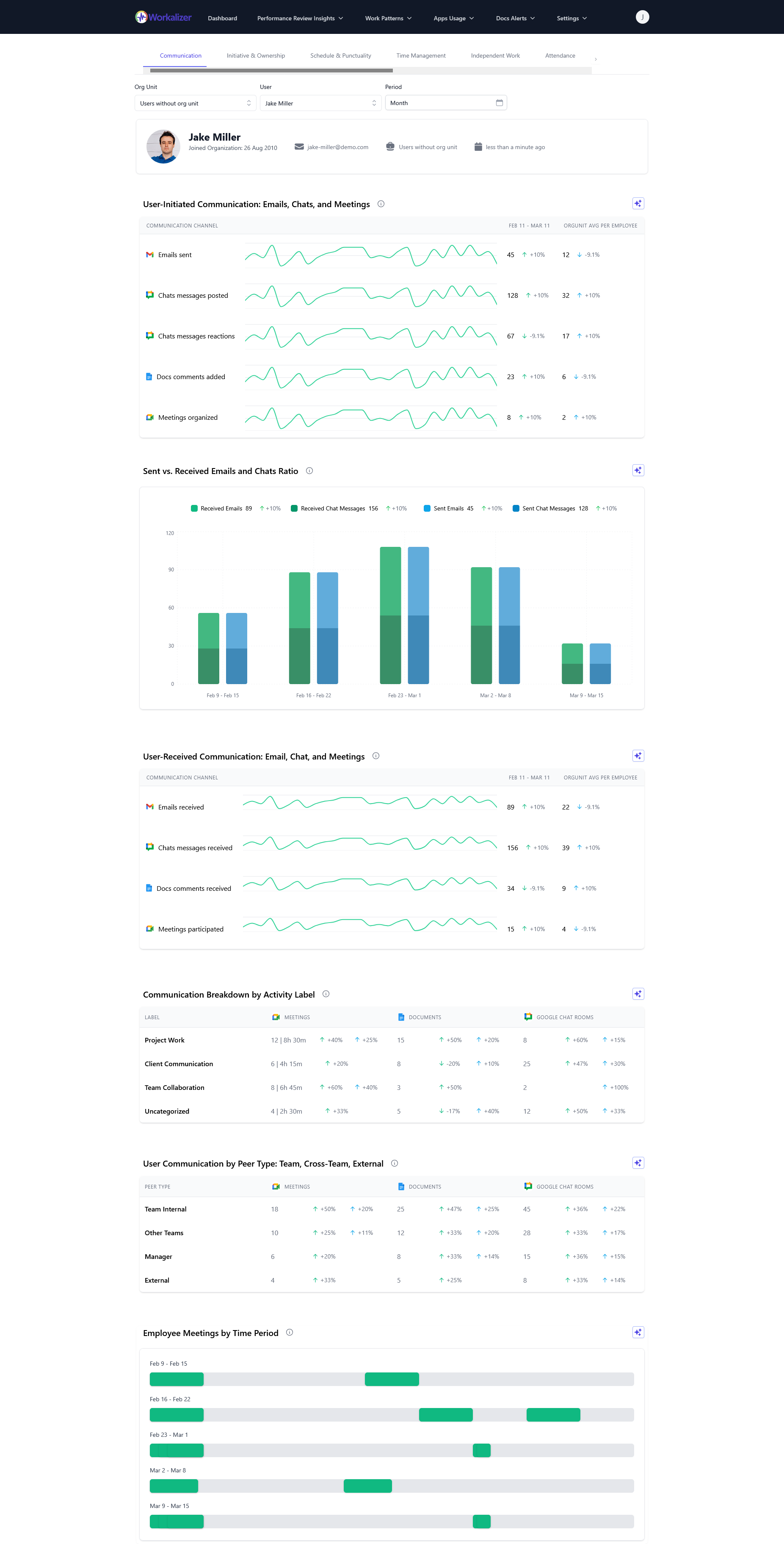
- Monitor Usage and Engagement: Use the How to Use the Google Workspace Dashboard to get a holistic view of team activity. This helps identify if provisioned tools are actually being utilized, informing future licensing decisions and training needs. You can see at a glance who is active and where.
- Optimize Collaboration and Meetings: Beyond just the google meet call duration limit, Workalizer provides detailed insights into meeting patterns and collaboration. This helps assess if premium Google Meet features are truly needed or if standard access suffices, optimizing costs and ensuring efficient communication.
- Enhance Data Security and Compliance: The How to Use the Google Drive Shared Files Report is invaluable for IT and HR. It allows you to audit shared files, identify potential google drive public file exposures, and ensure that sensitive data isn't accessible post-offboarding. This is a critical layer of security that an HRIS-ITSM integration provisions but doesn't actively monitor in detail.
- Streamline Offboarding Audits: Even with automated deprovisioning, Workalizer provides the data to verify that access has been fully revoked and to identify any lingering activities or shared files associated with departing employees. This adds an essential layer of verification to your offboarding process.
By leveraging Workalizer, organizations can move beyond simply granting access to truly understanding and optimizing how their workforce uses Google Workspace, ensuring security, efficiency, and a better employee experience across the entire lifecycle.
Actionable Checklist for Better HRIS-ITSM Integration
Ready to move past the “integration illusion”?
- Audit Your Current State: Document all manual touchpoints between HRIS and ITSM. Where are the delays? What data is missing?
- Define Clear Requirements: What specific data points need to flow between systems? What events in the HRIS should trigger actions in ITSM (e.g., new hire, promotion, termination)?
- Evaluate Integration Options: Research API capabilities of your existing systems, explore iPaaS solutions, or consider dedicated IAM/IGA platforms.
- Engage Stakeholders: Bring HR, IT, Security, and Legal teams together. This is a cross-functional initiative.
- Phased Implementation: Start with critical workflows (e.g., onboarding/offboarding) and expand incrementally.
- Monitor and Optimize: Regularly review your integrated workflows. Use tools like Workalizer to monitor actual usage and ensure that provisioned access aligns with operational needs and security policies. Check your https workspace google com u 0 dashboard for overall health.
Conclusion
The days of HR and IT operating in separate silos are over. A truly connected HRIS and ITSM ecosystem is not just a “nice-to-have”; it's a strategic imperative for modern organizations. By investing in robust integration, you empower your teams, enhance security, and deliver a superior employee experience from day one to the last. And with tools like Workalizer, you gain the critical visibility to ensure that your integrated systems are not just connected, but also optimized for performance and security across your entire digital workspace.