Unlocking Peak Performance: How AI-Driven Insights Redefine Google Workspace Productivity in 2026
As a Senior Tech Writer at Workalizer.com, I’ve seen countless organizations grapple with the ever-evolving landscape of workplace productivity. The year 2026 is proving to be a watershed moment, demanding a radical rethinking of how we measure performance. The traditional metrics, subjective and often biased, are simply no match for the dynamic, AI-infused workflows powered by Google Workspace.
If you're an HR Leader, Engineering Manager, or C-Suite Executive, you know the stakes are higher than ever. Retaining top talent, fostering innovation, and driving efficiency aren't just buzzwords; they're existential imperatives. The good news? The very technology that complicates measurement is also the key to unlocking unprecedented clarity: AI-driven productivity insights.
The Shifting Sands of Productivity in the AI Era (2026)
The acceleration of AI integration into our daily tools is undeniable. Google, a powerhouse in AI innovation, continues to push boundaries. Just recently, they launched the Google DeepMind Accelerator program in Asia Pacific, focusing on tackling environmental risks with AI. While seemingly distinct from workplace productivity, this initiative underscores Google's pervasive commitment to embedding advanced AI, including their powerful Gemini models, across all their offerings – Google Workspace included.
This means that in 2026, the nature of work itself is fundamentally changing. Tasks once manual are now automated or augmented by AI. Gemini isn't just a chatbot; it's a co-creator in Docs, an analyst in Sheets, and a summarizer in Meet. The sheer volume of digital interactions – emails, chat messages, shared documents, video calls – has exploded. How do you accurately assess an individual's or team's contribution when their output is increasingly intertwined with AI's capabilities?
This challenge is precisely where traditional performance review systems falter. Relying on annual reviews, subjective manager feedback, or simplistic activity counts can not only miss the mark but actively harm morale and retention. In fact, we've explored this issue in depth in our post, Are Your 'Productivity' Metrics Actually Killing Performance in 2026? The answer, more often than not, is a resounding yes.
Navigating Information Overload with Smarter Analytics
Consider the typical workday: a deluge of emails, constant pings from Chat, and a steady stream of updates from Drive. For a manager, understanding true engagement and impact within this noise is nearly impossible without the right tools. When an employee shares a critical file, they might send a share link Google Docs to a team, but is that document then actively collaborated on, or does it sit unread? Similarly, receiving a google drive alert when folder modified might signal activity, but what kind of activity, and by whom, and what was its impact?
These granular interactions, when viewed in isolation, tell a fragmented story. But when analyzed holistically by an AI, they reveal patterns of collaboration, communication efficiency, and contribution that are invisible to the naked eye. Industry reports suggest that organizations leveraging AI for workplace analytics can see up to a 15% increase in team productivity by identifying and addressing bottlenecks proactively. This isn't about surveillance; it's about context and actionable intelligence.
Beyond Gut Feelings: The Imperative for Data-Driven Performance Insights
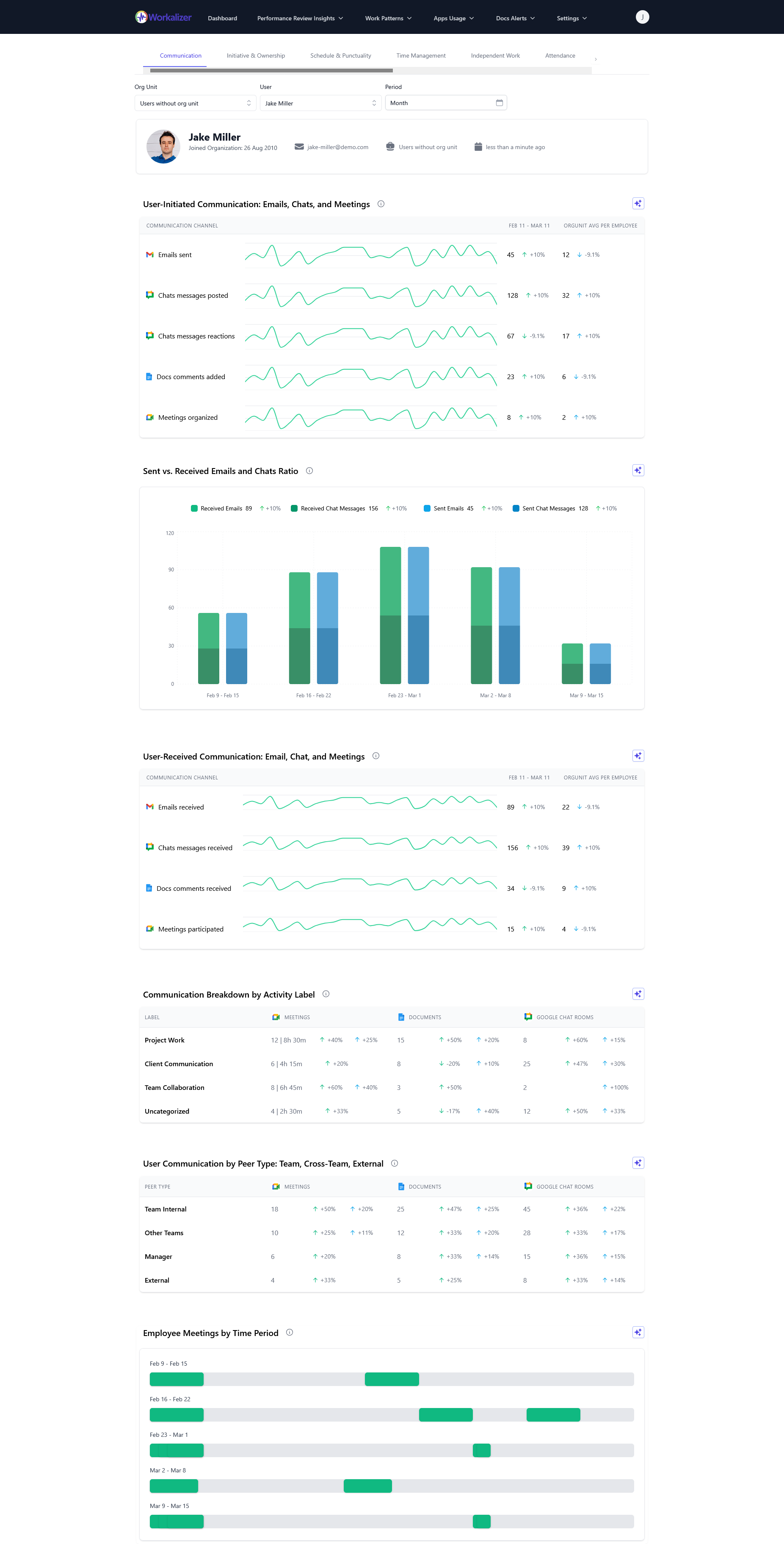
The era of gut-feeling performance reviews is over. In 2026, leaders need data, not anecdotes. Workalizer steps in as your unbiased lens, providing a comprehensive, data-driven understanding of how your teams truly operate within Google Workspace. We analyze signals from Gmail, Drive, Chat, Gemini, and Meet – not to track keystrokes, but to understand collaboration patterns, communication effectiveness, and overall engagement.
Imagine knowing, with objective data, which teams are collaborating most effectively on Drive projects, or which communication styles in Chat lead to quicker resolutions. This isn't about penalizing individuals; it's about empowering managers with the insights to coach, optimize, and celebrate genuine impact.
Unmasking True Collaboration and Impact
Our platform cuts through the noise to reveal who is truly contributing, who might be over-extended, and where communication breakdowns are occurring. For instance, an engineering team might be sending hundreds of emails, but are those emails leading to clear actions, or are they contributing to an inbox overload? Workalizer can distinguish between high-volume, low-impact communication and focused, high-value interactions. This level of detail helps pinpoint areas for improvement and fosters a culture of transparency and accountability.
The beauty of this approach is its inherent fairness. AI doesn't have personal biases. It doesn't play favorites. It simply processes the data, providing a factual basis for performance discussions. This can lead to a significant reduction in unconscious bias, a challenge that costs organizations billions annually in turnover and lost productivity.
Navigating the Future: AI as Your Co-Pilot in Talent Management
For HR Leaders, the implications are profound. Workalizer provides the tools to identify emerging leaders, spot potential burnout risks, and understand the true impact of training programs. For Engineering Managers, it means having a clear picture of project velocity, resource allocation, and team cohesion. For the C-Suite, it's about strategic insights into organizational health and efficiency, directly impacting the bottom line.
The future of work, heavily influenced by the agentic AI wave, demands a proactive approach to talent management. Organizations that fail to adapt their performance measurement strategies will be left behind, struggling with high turnover, disengaged employees, and an inability to leverage their most valuable asset: their people.
By integrating Workalizer's insights, companies can shift from reactive problem-solving to proactive optimization. This means identifying bottlenecks before they become critical, nurturing high-potential employees with targeted development, and ensuring that every team member is positioned for success. Data from a recent study published by Forrester indicates that companies adopting AI-powered HR analytics see an average of 20% improvement in employee retention rates within two years.
Workalizer's Edge: Your Blueprint for an AI-Optimized Workforce
Workalizer isn't just another analytics tool; it's a strategic partner in building a high-performing, engaged, and equitable workforce. We provide the clarity you need to make informed decisions, move beyond subjective assessments, and cultivate a culture of objective growth.
In 2026, the question isn't if AI will transform your workplace, but how effectively you will harness its power for your people. Don't let your performance reviews be a relic of the past. Embrace the future of data-driven insights and empower your teams to achieve their full potential. Discover how Workalizer can transform your Google Workspace usage into a blueprint for unparalleled organizational success. Request a demo today and redefine productivity for the AI era.