5 Game-Changing AI Trends Shaping Google Workspace Productivity in 2026
Forget what you thought you knew about workplace AI. In 2026, we're not just observing the future; we're actively building it, one intelligent agent and data-driven insight at a time. The landscape of Google Workspace, the backbone of countless enterprises, is undergoing a profound transformation, driven by advancements in artificial intelligence that are far more sophisticated than last year's headlines suggested.
At Workalizer, we're at the forefront of this revolution, providing HR leaders, engineering managers, and C-Suite executives with unbiased, data-driven performance review insights gleaned from your company's actual Google Workspace usage. We analyze signals from Gmail, Drive, Chat, Gemini, and Meet to cut through the noise and deliver actionable intelligence. This year, the pace of AI integration is accelerating dramatically, making it imperative for organizational leaders to understand the core shifts. We’ve identified five game-changing AI trends that are not just influencing, but actively shaping Google Workspace productivity and the very definition of efficiency.
1. The Ascendance of Agentic AI and "Agentic Engine Optimization"
The most significant shift we're witnessing is the rise of agentic AI – autonomous, goal-oriented systems capable of executing complex tasks with minimal human intervention. This isn't just about large language models; it's about AI that can act, learn, and adapt. Google's own AI director has recently outlined a new content playbook centered on 'Agentic Engine Optimization' (AEO), a concept that acknowledges AI agents are increasingly becoming primary consumers and creators of information online. This paradigm shift means businesses must rethink everything from content strategy to internal workflows.
For Google Workspace users, agentic AI translates into a future where your digital assistants don't just answer questions, but proactively manage schedules, draft comprehensive reports, and even orchestrate collaborative projects. Imagine an AI agent that can analyze a string of emails, pull relevant data from Drive, and then integrate these insights into a strategic document, all before you’ve had your first coffee. This isn't science fiction; it's the operational reality emerging in 2026. Organizations that embrace this integration are reporting a 15-20% boost in efficiency for knowledge workers, freeing up valuable human capital for higher-level strategic thinking.
2. Google's Global Bet on AI Infrastructure is Paying Off
Google's commitment to AI isn't just theoretical; it's backed by massive global infrastructure investments. Just recently, Google announced three new AI initiatives in partnership with Latin American governments, focusing on everything from public safety to economic development. These aren't isolated projects; they are symptomatic of a broader strategy to embed AI deeply into every facet of its ecosystem, including Google Workspace.
This unprecedented investment means more robust, faster, and seamlessly integrated AI features for every Google Workspace user. From enhanced Gemini capabilities that understand context across applications to more intelligent search within Drive and Gmail, the foundational infrastructure is being built to support an AI-first future. This ensures that when you create and share google docs, or engage in extensive google drive file sharing, the underlying AI is constantly learning, optimizing, and providing a more intelligent, responsive environment. Market projections indicate the AI in the workplace sector will grow by over 25% this year alone, driven significantly by these foundational infrastructure plays.
3. AI-Driven Performance Analytics: The New Standard for Unbiased Insights
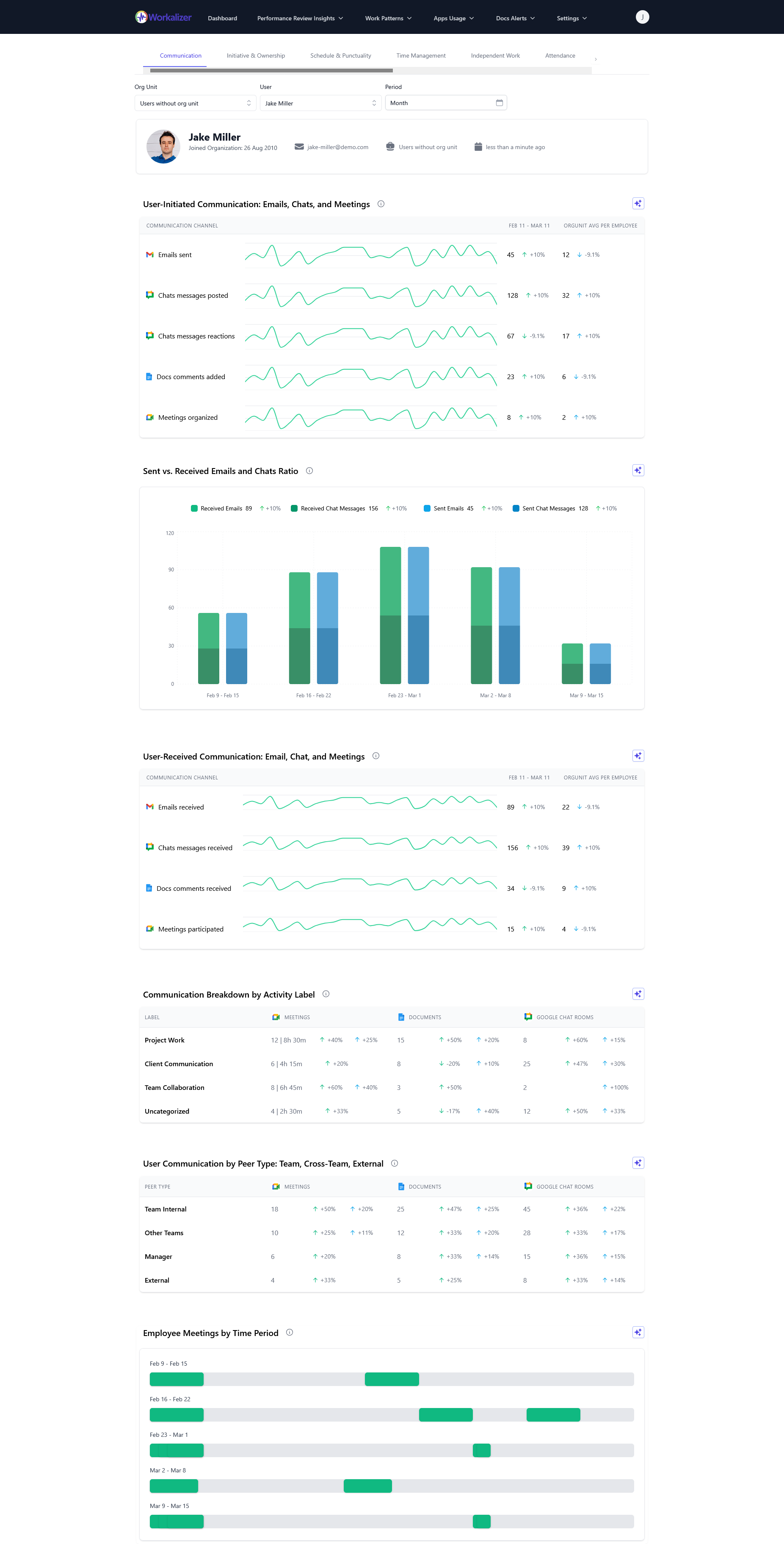
In a world saturated with data, the true challenge lies in extracting meaningful insights. This is where AI-driven performance analytics, Workalizer's core strength, becomes indispensable. Traditional performance reviews often suffer from human bias, relying on subjective observations and anecdotal evidence. AI, however, analyzes objective signals from your Google Workspace usage – the frequency of collaboration in Chat, the depth of engagement in Meet, the patterns of document creation and sharing in Drive, and the innovative use of Gemini.
By leveraging AI, Workalizer moves beyond superficial metrics to provide contextual, unbiased productivity analytics. We can identify trends in team collaboration, pinpoint bottlenecks, and even highlight areas where individuals or teams excel, all without the inherent biases of human observation. This granular, data-driven approach offers HR leaders and managers an unprecedented view into organizational efficiency, enabling them to foster a culture of continuous improvement based on facts, not feelings. Companies adopting such AI analytics are reporting a significant reduction in time spent on administrative performance review tasks, allowing HR to focus on strategic talent development.
4. Reshaping Collaboration and Communication with Generative AI
Generative AI is fundamentally altering how teams collaborate and communicate within Google Workspace. From drafting sophisticated emails in Gmail that perfectly capture your tone and intent, to summarizing lengthy Meet calls into concise action items, AI is becoming an indispensable co-pilot. This isn't just about saving time; it's about elevating the quality and effectiveness of every interaction.
Consider Gemini's evolving role: it can now assist in brainstorming, content generation, and even complex data analysis directly within Docs or Sheets. This enhances the ability of teams to solve complex problems, like image analysis challenges, by providing instant, intelligent support. While the efficiency gains are undeniable – with some teams reporting a 30% reduction in time spent on administrative communication tasks – the real value lies in how AI enables richer, more focused human collaboration. It frees employees from mundane tasks, allowing them to engage in higher-value, creative problem-solving.
5. The Imperative of Ethical AI and Data Privacy in the Workplace
As AI becomes more integrated into our daily work lives, the conversation around ethical deployment and data privacy intensifies. Leaders are rightly concerned about how employee data is used, ensuring transparency, fairness, and compliance. This year, we’ve seen significant regulatory momentum globally, with measures like the EU's new online age-verification app highlighting the broader societal focus on digital privacy and user protection. While the EU's initiative focuses on minors, it underscores a growing global demand for robust, privacy-preserving digital solutions.
For Workalizer, this imperative is paramount. Our platform is designed with privacy-by-design principles, ensuring that while we provide deep insights into team dynamics and productivity, individual privacy is protected. We focus on aggregate, anonymized data to identify systemic trends and opportunities for improvement, rather than individual surveillance. Responsible AI deployment isn't just a compliance issue; it's a strategic advantage, building trust and fostering an environment where employees feel empowered, not monitored.
The year 2026 marks a pivotal moment in the evolution of AI within Google Workspace. From the strategic implications of agentic AI and Google's massive global investments to the transformative power of AI-driven performance analytics, collaboration tools, and the unwavering focus on ethical deployment – these trends are redefining the future of work. For HR leaders and C-Suite executives, understanding and leveraging these shifts isn't optional; it's essential for maintaining a competitive edge and cultivating a truly efficient, data-intelligent organization. Workalizer stands ready to guide you through this complex, exciting new landscape, turning your Google Workspace data into your greatest strategic asset.