3 Critical Shifts Driving Peak Performance & Productivity in 2026
The drumbeat of change in the corporate world is relentless. As we navigate March 2026, the question isn't *if* your organization needs to evolve, but *how swiftly* and *how intelligently* it can adapt to the new realities of work. Traditional performance management, shackled by subjective biases and lagging indicators, is officially obsolete. What's taking its place? A data-driven, AI-powered paradigm that promises not just incremental gains, but a fundamental shift in how we understand, measure, and cultivate peak performance and productivity.
At Workalizer, we've witnessed firsthand the transformative power of leveraging real-time signals from Google Workspace — Gmail, Drive, Chat, Gemini, and Meet — to provide unbiased, actionable insights. This isn't about surveillance; it's about clarity, fairness, and empowering your teams. This year, HR leaders, engineering managers, and C-suite executives who embrace these shifts will not only survive but thrive.
The New Reality: Why Traditional Performance Metrics Fall Short in 2026
The workplace landscape has fragmented. Remote work is no longer a niche benefit; it's a foundational element for most organizations. Consider this: as of late last year, an astounding 79% of employees spend at least some portion of their time working remotely, with another 52% juggling hybrid setups. This massive shift, detailed in a report by Productivity Shift, means that the casual hallway conversations and visual cues that once informed performance assessments are largely gone. You can't simply 'pop over' to gauge someone's productivity or focus.
In this distributed environment, relying on annual reviews and anecdotal evidence is like trying to navigate a spaceship with a compass. It's insufficient. It breeds bias, overlooks critical contributions, and fails to identify areas for support and development in a timely manner. The need for objective, continuous, and data-driven insights into how teams collaborate, prioritize, and utilize their tools has never been more urgent.
3 Critical Shifts Driving Peak Performance and Productivity in 2026
To truly unlock organizational efficiency and foster a culture of high performance this year, you must lean into these three transformative areas:
1. Embracing AI for Proactive Performance Management
Artificial intelligence is no longer a futuristic concept; it's an immediate imperative for HR and leadership. The capabilities of AI have been growing exponentially, offering unprecedented opportunities to enhance continuous talent management. Primalogik highlights five key applications of AI in performance management that are already reshaping our approach:
- Strengthening Feedback Practices: AI can summarize vast amounts of unstructured feedback, identifying key themes and sentiment, making reviews more comprehensive and less time-consuming.
- Understanding Employee Engagement: By analyzing communication patterns and activity within platforms like Google Workspace, AI can surface early indicators of disengagement or burnout, allowing for proactive intervention.
- Optimizing Performance Analysis: AI can correlate activity data with outcomes, providing a clearer picture of what drives success and where bottlenecks exist.
- Proactive Management: Identifying potential performance dips or emerging skill gaps before they become critical issues.
- Personalized Training and Development: Tailoring learning paths based on individual performance data and career aspirations.
However, it's crucial to acknowledge the risks. Concerns about bias, employee trust, and model limitations necessitate robust ethical policies and a system of checks and balances. AI should serve as an add-on, a powerful analytical co-pilot, not a quick fix or a replacement for human judgment. For a deeper dive into the broader implications, explore our recent post, The Future of Agentic AI: What to Expect for Enterprise Productivity in 2026.
2. Automating Workflows: Reclaiming Lost Hours and Dollars
The automation revolution is not just here; it's delivering tangible ROI. If your teams are still bogged down by repetitive, manual tasks, you're hemorrhaging precious time and money. McKinsey research, as cited by Productivity Shift, reveals a staggering truth: 60% of employees could save 30% of their time with workflow automation. That's a recovery of 12 hours a week from a standard 40-hour work schedule!
The data becomes even more compelling: 51% of employees spend at least two hours a day on repetitive functions that are ripe for automation. For businesses, this translates directly to the bottom line, with companies leveraging workflow automation saving an average of $46,000 per year. Imagine the strategic initiatives, innovation, and high-value work your teams could be focusing on if those hours were reclaimed.
In the context of Google Workspace, this means streamlining everything from document approvals in Drive to meeting scheduling in Meet, and even intelligent email management in Gmail. Automation isn't just about big systems; it's about optimizing daily collaboration. Imagine the time saved when your team no longer struggles with how to email large files with Google Drive manually, or when a crucial project update is instantly accessible via a simple google drive copy link shared within an automated chat channel, all thanks to intelligent workflow design. Workalizer helps you identify where these manual inefficiencies are occurring by analyzing the flow of work within your Google Workspace ecosystem.
3. Data-Driven Prioritization for Distributed Teams
With 79% of employees working remotely or hybrid, the challenge of keeping everyone focused and aligned across time zones and diverse workloads is monumental. It goes far beyond a basic to-do list. Effective daily prioritization for remote teams requires a genuine system that tackles the coordination headaches of distributed work: the timezone juggling, the invisible workload duplication, and the feeling of being stuck in silos.
While frameworks like the Eisenhower Matrix or Time-Blocking are excellent starting points, the real power comes from understanding actual work patterns. Workalizer analyzes signals from your Google Workspace — who's collaborating on what in Drive, the intensity of communication in Chat, meeting participation in Meet, and even Gemini usage for research — to provide managers with an objective view of team focus and effort. This allows for proactive adjustments to priorities, ensures alignment, and prevents burnout from invisible workloads. It's about moving from guesswork to informed decision-making, ensuring that the vital few tasks are always prioritized over the trivial many.
The future of enterprise productivity, as we discussed in a previous article, The Future of Enterprise Productivity: Beyond Apps and Into the AI-Driven Era of 2027, is inextricably linked to these AI-driven shifts.
Workalizer's Edge: Unlocking Unbiased Productivity Analytics
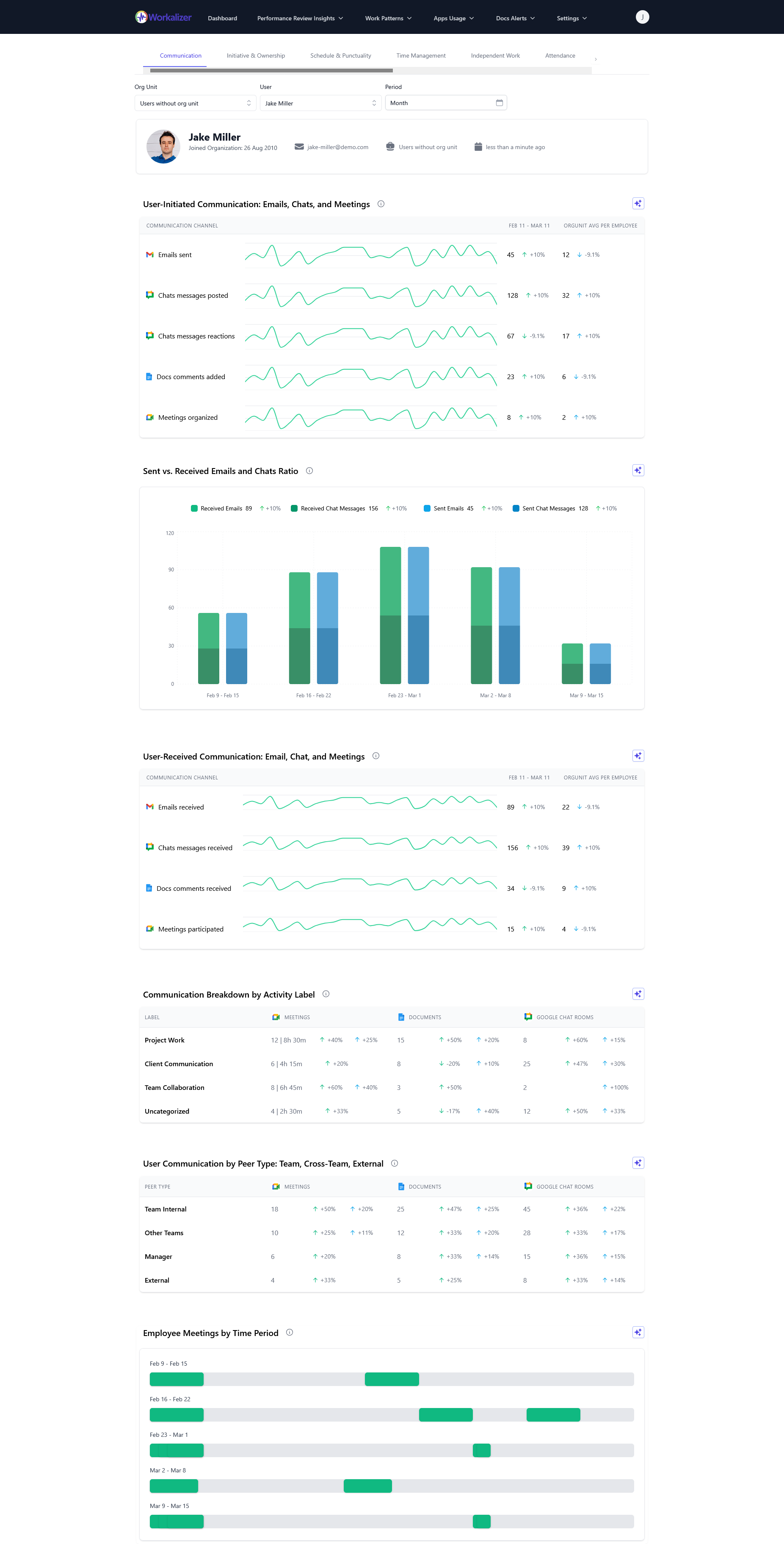
This is where Workalizer steps in. We are an AI-powered platform purpose-built to provide performance review insights based on your company's actual usage of Google Workspace. We analyze critical signals from Gmail, Drive, Chat, Gemini, and Meet to deliver data-driven, unbiased productivity analytics. Our platform cuts through the noise, providing HR leaders and managers with the objective evidence they need to:
- Identify high-impact contributors.
- Uncover collaboration bottlenecks.
- Understand resource allocation.
- Foster equitable performance assessments.
- Guide personalized development paths.
We believe in empowering people with facts, not just feelings, to cultivate a truly high-performing and efficient organization.
The Road Ahead: Your Strategic Imperative for 2026 and Beyond
The year 2026 demands a strategic pivot. Relying on outdated performance management practices is no longer an option; it's a competitive disadvantage. HR leaders, engineering managers, and C-suite executives must embrace the power of AI and automation, underpinned by robust data analytics, to understand and optimize their workforce's true potential.
By adopting these three critical shifts — AI for proactive performance, workflow automation for efficiency, and data-driven prioritization for distributed teams — you're not just improving metrics. You're building a more resilient, equitable, and intelligent organization, ready to tackle the challenges and seize the opportunities of tomorrow. The time to act is now; the data is waiting to guide you.