The Future of Agentic AI: What to Expect for Enterprise Productivity in 2026
As a Senior Tech Writer at Workalizer.com, I’ve watched the AI landscape evolve from a curious novelty to an indispensable engine of enterprise. Today, Friday, March 20, 2026, we stand at a pivotal moment: the undeniable ascendance of Agentic AI. This isn't just about AI as a tool; it's about AI as an autonomous, decision-making partner, fundamentally reshaping how we work, manage, and innovate. For HR Leaders, Engineering Managers, and C-Suite Executives, understanding this shift isn't optional—it's critical for competitive advantage.
Gone are the days when AI merely assisted; now, it anticipates, acts, and optimizes with minimal human oversight. This transformation, driven by massive investments and strategic realignments across tech giants, promises unprecedented levels of productivity. But it also demands a new perspective on organizational efficiency and the very definition of work.
The Rise of Agentic AI: From Tools to Teammates
The most significant development in the AI space this year is the aggressive pivot towards agentic capabilities. OpenAI, for instance, is reportedly developing a "super app" for desktop, unifying ChatGPT, its browser, and its Codex app. This isn't just about convenience; it's about creating a single, powerful entity capable of performing complex tasks like writing software or analyzing vast datasets with remarkable autonomy. As OpenAI Chief of Applications Fidji Simo noted in an internal memo, the company is "orienting aggressively" towards high-productivity use cases, recognizing that previous fragmentation was "slowing us down and making it harder to hit the quality bar we want."
This strategic refocus underscores a broader industry trend: the move from discrete AI tools to integrated, proactive agents. These agents aren't waiting for explicit instructions for every single step; they're designed to understand objectives, break them down, and execute multi-stage tasks, often leveraging other digital tools as needed. This shift is precisely what we highlighted in our recent deep dive, The Next Frontier of Productivity: Agentic AI's Evolving Role in Google Workspace for 2026, emphasizing how these intelligent systems are becoming integral to our digital workspaces.
Automating the Enterprise: Efficiency at Scale
The impact of agentic AI extends far beyond the digital desktop, manifesting in tangible, physical automation that redefines operational efficiency.
Robotics and Logistics: Amazon's Autonomous Leap
Amazon's relentless march towards automation continues unabated. The acquisition of autonomous robotics startup Rivr, valued at $110 million in August 2024, is a clear signal of this intent. Rivr's four-legged, wheeled robots are engineered to navigate challenging, uneven surfaces, promising to further enhance Amazon's capabilities for ever-faster and more efficient package deliveries. With Amazon having deployed its one millionth robot last summer (2025) and setting future goals for automating 75% of all its operations, the scale of this transformation is staggering. This isn't just about speed; it's about resilience, cost reduction, and the ability to operate at a scale previously unimaginable.
In a parallel move, the transportation sector is bracing for its own agentic revolution. Uber and Rivian recently struck a monumental $1.25 billion robotaxi deal. Uber's commitment to invest in Rivian, contingent on the latter hitting autonomous performance milestones, will see 10,000 fully autonomous Rivian R2 robotaxis deployed in the first phase, with an option for up to 40,000 more by 2030. Commercial service is slated to begin in San Francisco and Miami by 2028, expanding to 25 cities across North America and Europe by 2031. This partnership, unique in its reliance on Rivian's end-to-end proprietary silicon and autonomy software, highlights a future where transportation is not just automated, but intelligently orchestrated.
Data-Driven Wellness: Google's AI-Powered Fitbit
Beyond logistics, AI is also making deeply personal inroads, promising to enhance human potential. Google's plans to infuse Fitbit with AI, integrating personal health data with medical records, represents a significant step towards predictive and personalized wellness. Imagine an AI agent analyzing your activity, sleep, and medical history to provide tailored health recommendations, flag potential issues, and even proactively suggest adjustments to your work-life balance to optimize performance. For enterprises, this offers unprecedented opportunities for proactive employee wellness programs, potentially leading to reduced healthcare costs, increased engagement, and a more productive workforce.
The Human-AI Collaboration: New Models for Engagement
As AI becomes more agentic, the nature of human-AI collaboration is also evolving, creating new economic models and refining our digital interactions.
Compensated AI Training: DoorDash's Innovative Approach
The ethical implications of AI training data have been a hot topic, with numerous lawsuits against companies for unauthorized use of copyrighted materials. DoorDash is responding with an innovative model: paying its gig workers for creating content to train AI models. Through its new "Tasks" program, Dashers can earn extra cash by performing activities like taking pictures of restaurant dishes or recording unscripted conversations in various languages. This content is crucial for training AI and robotics models, not just for DoorDash but also for its partners in retail, insurance, hospitality, and tech, as reported by Engadget. This approach sets a precedent for ethical AI development, demonstrating a commitment to direct compensation for data contributions.
Streamlining Workflows: The Google Workspace Advantage
For organizations deeply embedded in the Google Workspace ecosystem, agentic AI promises to revolutionize daily operations. Imagine an AI agent not just suggesting grammar corrections, but proactively managing an entire project's documentation, updating a collaborative Google Doc with meeting notes from a recorded Meet session, or compiling relevant Drive files for a presentation. This goes beyond simple automation; it's about intelligent orchestration of information and tasks.
Consider the complexities of information sharing: can you share files on Google Drive securely and efficiently, ensuring the right people have access at the right time, without manual oversight? An agentic AI, trained on your company's policies and project structures, could manage access permissions, suggest optimal sharing settings, and even flag potential data leakage risks, all while maintaining an audit trail. This level of intelligent assistance frees up valuable human capital for higher-level strategic work.
Furthermore, agentic AI can significantly enhance team collaboration and project management. Think of an AI actively participating in your daily standups, not just transcribing but summarizing progress, identifying roadblocks, and even suggesting action items based on real-time data from Gmail, Chat, and Drive. This is the future we explored in Supercharge Your Agile Daily Standup with AI and Google Workspace, where AI becomes a vital, proactive part of your team's rhythm.
The Workalizer Perspective: Measuring the Unseen Productivity
The advent of agentic AI means that traditional metrics for productivity will no longer suffice. When AI agents are autonomously performing tasks, how do HR leaders and C-suite executives accurately measure the impact on team performance, collaboration, and overall organizational efficiency? This is where Workalizer.com becomes indispensable.
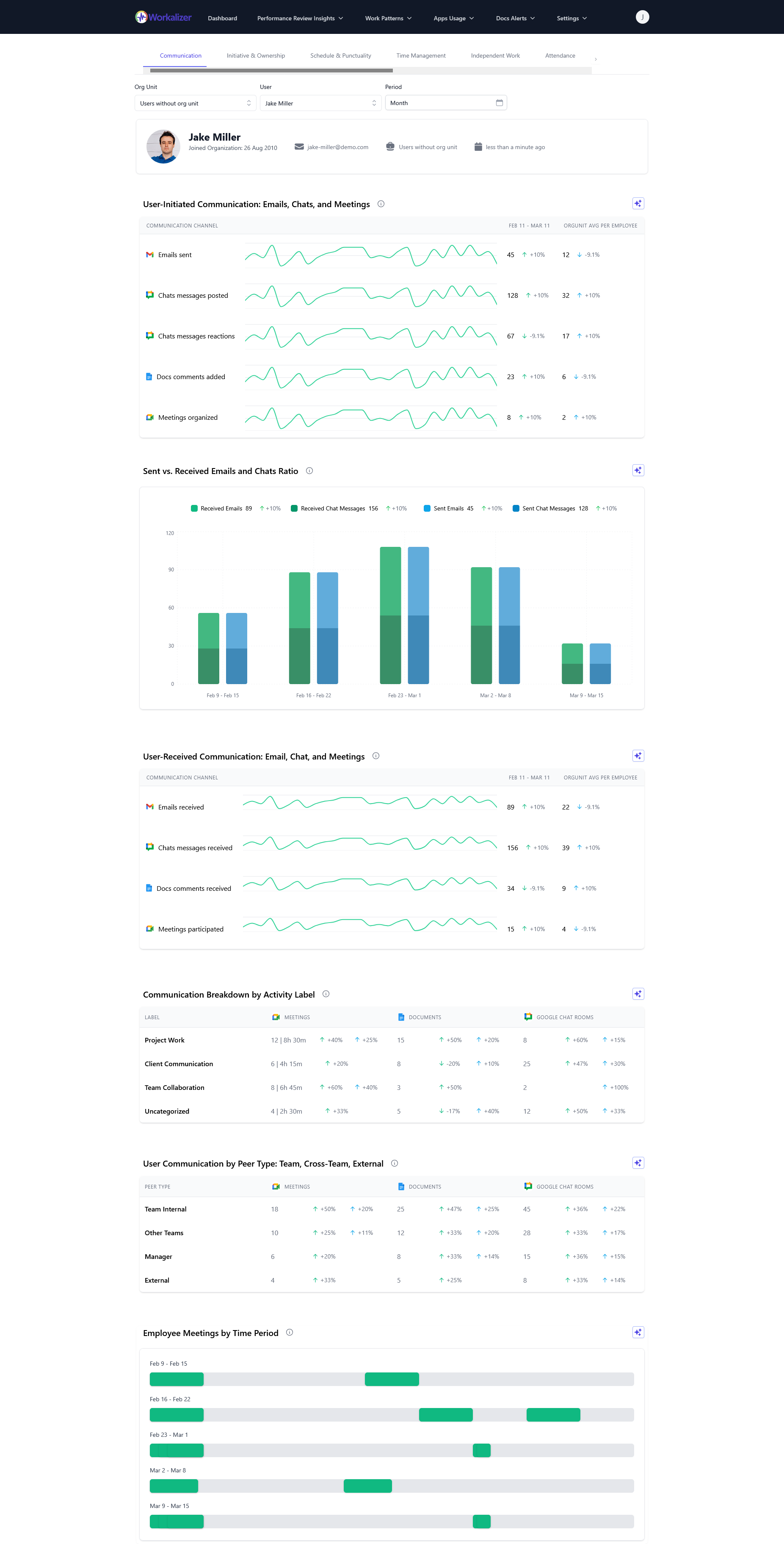
Our AI-powered platform provides data-driven, unbiased performance review insights by analyzing signals from your company's usage of Google Workspace—Gmail, Drive, Chat, Gemini, and Meet. As agentic AI integrates more deeply into these platforms, Workalizer will be your compass, helping you understand:
- How AI-driven task automation is affecting human collaboration patterns.
- The true efficiency gains from agentic systems, beyond anecdotal evidence.
- Where human intervention is still most valuable, and where AI can take the lead.
- The impact of AI adoption on employee engagement and skill development.
The future of work, propelled by agentic AI, is here. It’s a future of unprecedented efficiency, intelligent automation, and redefined human-computer interaction. But navigating this landscape successfully requires more than just adopting new technology; it demands a sophisticated understanding of its impact. Workalizer is built precisely for this purpose: to provide the clarity and insights you need to lead your organization through this transformative era. Embrace the agentic future, and let data be your guide.