Master Agentic AI: How to Drive Unprecedented Efficiency in Your Google Workspace This Year
Forget everything you thought you knew about AI in the workplace. As of Friday, May 22, 2026, the game has fundamentally changed. We’re moving beyond the era of simple chatbots and conversational AI. The future, unequivocally, belongs to agentic intelligence. This isn't just about asking an AI a question and getting an answer; it's about AI systems that can independently plan, execute, and iterate on complex tasks with minimal human intervention. And for leaders leveraging Google Workspace, this shift is not merely an upgrade—it's a revolution in organizational efficiency.
At Workalizer, we've been tracking these developments closely, and the signals from Google's recent I/O developer conference are crystal clear: agentic AI is no longer a futuristic concept; it's here, it's powerful, and it's poised to redefine productivity metrics across every enterprise. But like any seismic shift, it brings both immense opportunity and the critical need for clear, unbiased measurement. How do you ensure your multi-million dollar AI investments are translating into tangible performance gains? Let’s dive in.
The Dawn of Agentic Intelligence: Beyond Conversational AI
For years, AI's promise in the enterprise often felt limited to automating repetitive tasks or providing quick information retrieval. While valuable, these applications barely scratched the surface of AI's true potential. Now, with Google's bold pivot, we’re witnessing the emergence of AI agents designed to act autonomously, managing entire projects or coding pipelines from inception to completion. This isn't a conversational partner; it's a digital colleague capable of strategic execution.
The groundwork for this shift is already widespread. A recent ZDNET report from earlier this year confirmed that an astounding 96% of IT professionals are already using AI in some capacity. This widespread adoption sets the stage for the next leap: agentic applications that move beyond simple tool usage to independent task completion. This year, we're seeing the strategic deployment of AI that doesn’t just assist but actively drives outcomes.
Gemini 3.5 Flash: The Engine of Next-Gen Productivity
The cornerstone of this agentic revolution is Google’s new Gemini 3.5 Flash. Unveiled at Google I/O on May 19, 2026, this model is Google's strongest yet for coding and autonomous AI agents. Koray Kavukcuoglu, DeepMind’s chief technologist, highlighted its incredible capabilities: it can independently execute entire coding pipelines, manage complex research projects, and even build an operating system entirely from scratch in internal tests. This isn't just an incremental improvement; it's a qualitative jump in AI's ability to perform real work.
What truly sets Gemini 3.5 Flash apart is its speed and efficiency. It outperforms its predecessor, 3.1 Pro, on nearly all benchmarks, including coding, agentic tasks, and multimodal reasoning. Crucially, it's 4x faster than other frontier models, with an optimized version boasting an astounding 12x speed increase while maintaining the same quality. This unparalleled speed is vital for agentic workloads, where multiple AI agents run simultaneously on long-running tasks, as demonstrated with Google’s Antigravity agentic development platform. For HR leaders and engineering managers, this means a future where critical, time-consuming tasks can be offloaded to highly efficient digital assistants, freeing up human talent for higher-value, strategic endeavors.
AI Agents in Action: Transforming Google Workspace
Google isn't just building powerful models; they're integrating these agents directly into the fabric of daily work, particularly within Google Workspace. This year, we're seeing two key agentic applications designed to enhance both organizational and personal productivity:
- Information Agents: A powerful reinvention of Google Alerts, these AI agents operate 24/7 in the background. They can keep your teams updated on critical market trends, track competitor pricing, or provide real-time alerts on project-critical information. Imagine an agent continuously scanning industry news and compiling daily executive summaries, saving countless hours of manual research.
- Gemini Spark: This is the personal AI agent designed to navigate and manage your digital life within Google products like Gmail, Google Docs, and the broader Google Workspace ecosystem. Gemini Spark can surface key themes from lengthy newsletters, help organize inventory, or even assist in planning and managing group projects. While Google's initial consumer pitches for Spark have faced some confusion, as noted by TechCrunch in their May 21, 2026, coverage of Google's AI agent ecosystem, its enterprise applications are profound.
The potential for these agents to transform how teams collaborate and manage information is immense. As we explored in our recent post, The Future of Agentic AI: Unlocking Next-Gen Productivity in Google Workspace by 2027, these capabilities are just the beginning of a more autonomous and efficient work environment.
Streamlining Collaboration and Document Management
Consider the everyday workflows within Google Workspace. AI agents can act as intelligent assistants, proactively identifying gaps or opportunities. For instance, an agent monitoring project communications could suggest that a team needs to how to create a shared document in Google Drive for a new project brief, automatically drafting an initial outline based on meeting notes. Or, when a critical deliverable is finalized, an agent could guide users on how to share a Google file securely with external stakeholders, ensuring compliance with organizational policies while accelerating information flow.
This level of integration moves beyond simple automation; it's about intelligent orchestration of tasks that traditionally require significant human oversight. By optimizing these foundational elements of collaboration, agentic AI helps teams work smarter, not just harder.
The Productivity Paradox: Measuring Real Impact
However, with every technological leap, there's a crucial question: is this truly making us more productive? As we've discussed in Is AI's Billion-Dollar Bet on Productivity Already Losing? The Harsh Realities of 2026, the mere presence of AI doesn't guarantee a return on investment. The challenge for HR leaders, engineering managers, and C-suite executives in 2026 is not just to adopt agentic AI, but to quantify its impact. How do you measure the efficiency gains from an agent building an OS, or a personal AI synthesizing newsletters? The traditional metrics often fall short.
This is where the 'productivity paradox' of AI emerges. We intuitively understand that these tools should make us better, faster, and more effective. Yet, without clear, data-driven insights, these investments risk becoming expensive experiments rather than foundational shifts in organizational performance. The sheer volume of AI activity, while impressive, can obscure the true value unless it's properly analyzed and contextualized.
Workalizer's Role: Unbiased, Data-Driven Insights
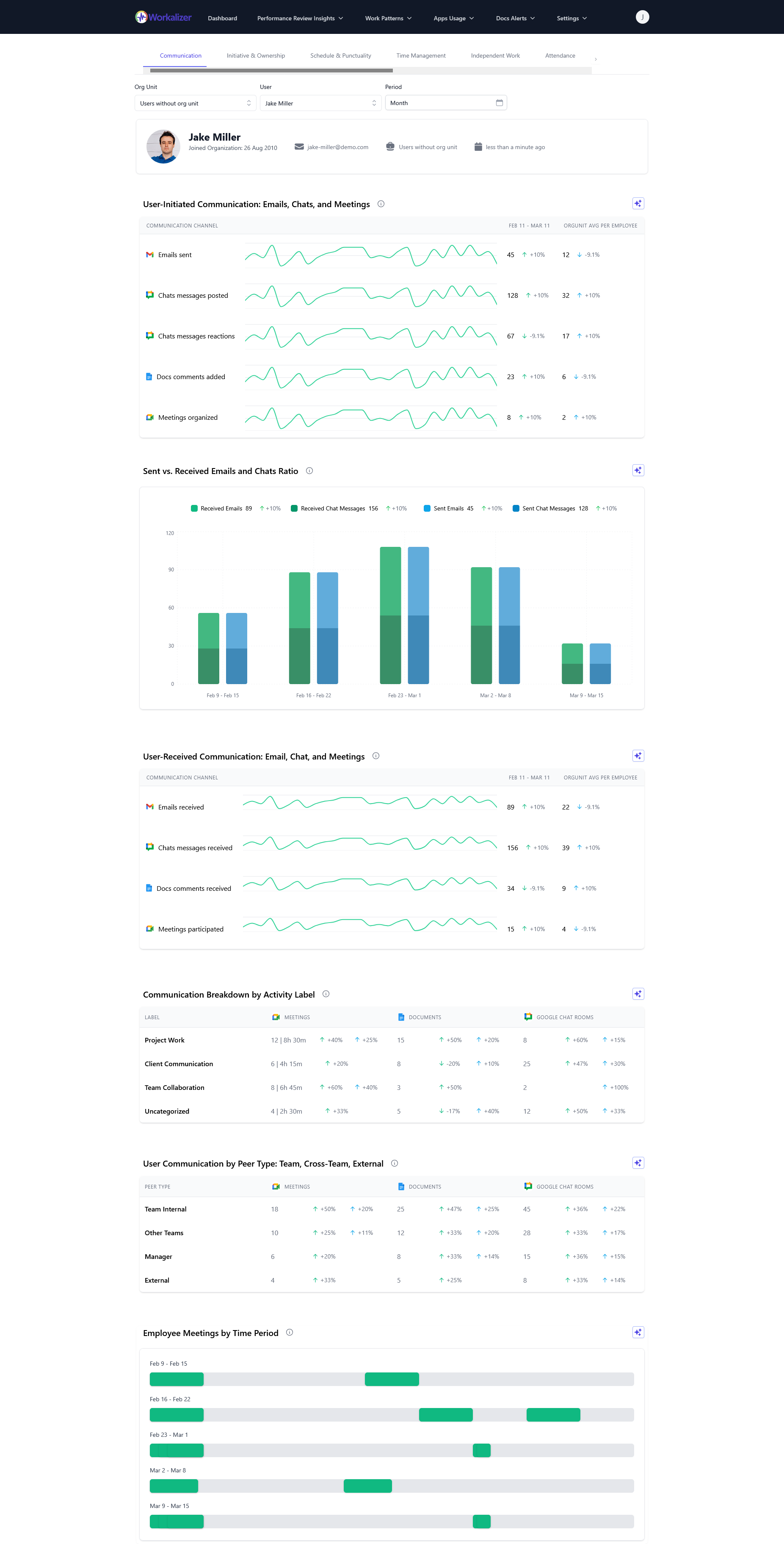
This is precisely the problem Workalizer was built to solve. We are an AI-powered platform providing performance review insights based on your company's usage of Google Workspace. As agentic AI becomes more prevalent, our platform becomes even more critical. We analyze signals from Gmail, Drive, Chat, Gemini, and Meet to provide data-driven, unbiased productivity analytics. This means:
- Quantifying Agentic Impact: We don't just see AI activity; we interpret it. Workalizer helps you understand how agent-driven tasks are contributing to project velocity, communication efficiency, and overall team output.
- Identifying Bottlenecks: Even with agents, human-AI collaboration can have friction points. Our analytics pinpoint where your teams might be struggling to integrate AI effectively, allowing for targeted training and process improvements.
- Unbiased Performance Reviews: In a world increasingly augmented by AI, traditional performance metrics can be skewed. Workalizer provides a holistic view, ensuring that individual and team contributions are assessed fairly, reflecting both human effort and AI leverage.
By leveraging Workalizer, you move beyond anecdotal evidence and into a realm of measurable, actionable insights. You can confidently answer whether your investment in agentic AI is truly delivering unprecedented efficiency.
Navigating the Agentic Future: A Call to Action for Leaders
The dawn of agentic AI, spearheaded by innovations like Gemini 3.5 Flash, represents a monumental opportunity for organizations committed to efficiency and innovation. This year, the imperative for HR leaders, engineering managers, and C-suite executives is clear: embrace this shift, but do so strategically.
Don't just deploy agents; integrate them thoughtfully into your workflows. More importantly, don't operate in the dark. Leverage platforms like Workalizer to gain clear, unbiased insights into how these powerful new tools are truly impacting your team's performance. The future of work in Google Workspace is agentic, intelligent, and, with the right analytics, measurably more productive.
This is not just a trend; it's the new operating model. Are you ready to master it?