3 Advanced Strategies for Maximizing Google Workspace Efficiency in 2026
As a Senior Tech Writer at Workalizer.com, I've seen countless organizations grapple with the promise and pitfalls of modern productivity suites. It's April 2026, and the digital landscape is more complex than ever. The tools we rely on—from Gmail to Gemini—are constantly evolving, yet many companies are still scratching the surface of their true potential. We're beyond the era of simply 'having' the tools; the challenge now is to master them, to unlock the deep efficiencies that lie hidden within our daily digital interactions.
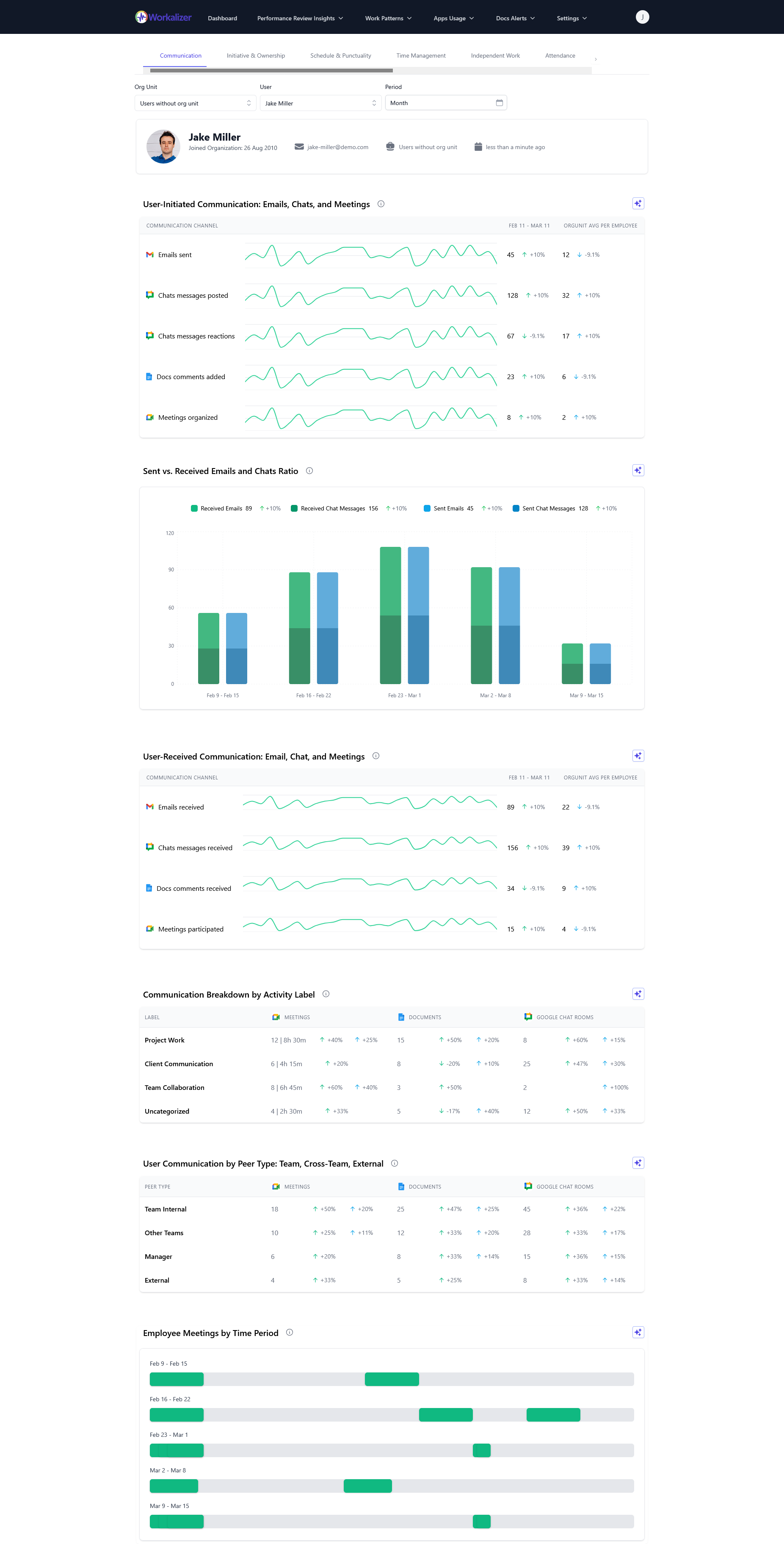
At Workalizer, we leverage AI to dissect your company’s Google Workspace usage, transforming raw data from Gmail, Drive, Chat, Gemini, and Meet into unbiased, actionable performance review insights. This isn't just about tracking activity; it's about understanding the 'how' and 'why' of productivity, helping HR leaders, engineering managers, and C-suite executives make truly data-driven decisions. This year, the focus isn't just on new features, but on strategic adoption. Let's dive into three advanced strategies that will redefine your organization's Google Workspace efficiency.
1. Reimagining Your Digital Workspace: Beyond the Single Screen
For years, many of us, myself included, dismissed features that seemed like mere embellishments. Take virtual desktops, for instance. I remember thinking, 'Why bother when I have multiple monitors?' Yet, as Rich Hein at How-To Geek eloquently put it on April 30, 2026, after years of ignoring them, he now can't work without Windows Virtual Desktops. His revelation wasn't about the technology itself, but about the profound impact it had on managing complex, multi-client workflows.
This isn't a plea for Windows features in a Google Workspace blog, but a critical insight: the principle of organized, task-specific digital environments is universally applicable. In 2026, our cognitive load from constant context-switching is a silent killer of productivity. Studies continue to show that even brief interruptions can take up to 23 minutes to recover from, leading to significant time wastage and increased error rates. For teams heavily reliant on Google Workspace, this means intentionally structuring your browser tabs, open Docs, Sheets, and even Chat windows into logical 'workspaces' for different projects or clients.
Think about it: do your employees spend valuable minutes searching for the right document, or navigating a chaotic sea of browser tabs? Workalizer's insights often reveal patterns of inefficient navigation and excessive context switching, indicating that employees are struggling to maintain focus across disparate tasks. By encouraging the creation of dedicated digital workspaces—whether through browser tab groups, multiple browser profiles, or even simply disciplined window management—we can drastically reduce mental overhead. This isn't just about personal preference; it's about engineering an environment where focus is the default, not an aspiration. If your organization's productivity tools feel like expensive shelfware, it might be time to address how your teams are actually using them. Read more on this topic in our recent post: Are Your Enterprise Productivity Tools Just Expensive Shelfware in 2026?
2. Unleashing Gemini's True Potential: Beyond the Basic Assistant
The advent of generative AI has transformed how we interact with our digital tools, and Gemini, Google's powerful AI, is at the forefront. Yet, a common mistake many users make is treating Gemini like an upgraded Google Assistant—a conversational interface for simple queries. As Joe Fedewa highlighted on How-To Geek on April 30, 2026, if you're using Gemini this way, you're missing out on its best features, particularly 'Connected Apps.'
Gemini isn't just about answering questions; it's about deeply integrating with your Google Workspace to *act* on information across your entire ecosystem. For HR leaders and C-suite executives, this means moving beyond simple prompts to strategic application. Imagine Gemini summarizing key discussions from a Meet transcript, drafting follow-up emails in Gmail based on Drive documents, or even helping to analyze data trends in Sheets, all while respecting your organization's data governance policies. The true power lies in its ability to connect these disparate data points and perform complex tasks autonomously or semi-autonomously.
Workalizer analyzes how your teams engage with Gemini. Are they leveraging its 'Connected Apps' functionality to its fullest, or are they underutilizing it? Our data can pinpoint departments or individuals who could benefit from targeted training on Gemini's advanced features, turning a conversational tool into a strategic productivity accelerator. Mastering Gemini's integrations can shave hours off administrative tasks, allowing your talent to focus on high-value, strategic work. For a deeper dive into maximizing this powerful AI, check out our article on Unlocking Gemini AI Plus Video: Navigating Missing Features and Credits on Your Google Suite Dashboard.
3. Streamlining Collaboration and Intelligent Asset Management
Efficient collaboration is the bedrock of modern enterprise. In 2026, simply sharing a document isn't enough; it's about *how* and *when* you share, and how effectively assets are managed. Google Drive and Docs are central to this, but their full potential is often untapped. Consider the challenge of uploading large video files to google drive for a marketing campaign or an engineering review. Without proper organization and clear sharing protocols, these assets can become black holes of productivity, slowing down project timelines and increasing storage costs.
The efficiency of your team can be dramatically impacted by how easily they can share in google docs, track changes, and co-create. Workalizer detects bottlenecks in these collaborative workflows. For instance, if a project consistently shows delays linked to document access issues or version control confusion, it's a clear signal for process improvement. We're also seeing a rise in smart content consumption as a form of efficiency. YouTube, for example, started rolling out free picture-in-picture (PiP) globally on Android and iOS this week, allowing users to consume longform, non-music content while multitasking. While seemingly a personal feature, this trend reflects a broader need for seamless information flow and parallel processing in our professional lives, underscoring the importance of tools that adapt to how we actually work.
Beyond basic sharing, implementing strict naming conventions, folder structures, and leveraging Drive's advanced search capabilities can transform asset management from a chore into a strategic advantage. For large organizations, this means setting clear guidelines and providing training to ensure consistency. When every team member knows exactly where to find and store critical files, the collective time saved adds up to significant gains in operational efficiency. It’s not just about the tools, but the disciplined, intelligent use of them.
The Workalizer Advantage: Turning Strategy into Action
These strategies aren't theoretical; they are immediately actionable steps that can yield tangible results. However, the true differentiator for successful implementation lies in measurement and continuous improvement. This is where Workalizer becomes indispensable.
We provide the data-driven insights to answer critical questions:
- Are your employees effectively organizing their digital workspaces, or are they overwhelmed by digital clutter?
- Is your investment in AI, particularly Gemini, translating into real productivity gains, or is it being underutilized?
- Are your collaboration workflows in Drive and Docs optimized, or are there hidden inefficiencies costing your organization time and money?
By analyzing the granular usage patterns within your Google Workspace, Workalizer offers an objective lens into your organizational efficiency. We empower HR leaders and executives with the data needed to identify high-performing teams, pinpoint areas for improvement, and tailor training programs that genuinely move the needle. In 2026, guessing is no longer a viable strategy for productivity. It's time to measure, analyze, and optimize with precision.
Ready to transform your organization's Google Workspace usage from good to exceptional? Contact Workalizer today for a personalized demo and discover how data-driven insights can unlock your team's full potential.