How to Future-Proof Performance Reviews with AI-Driven Productivity Insights
The End of Subjective Performance Reviews?
Let's face it: traditional performance reviews are often a minefield of bias, gut feelings, and outdated metrics. In 2026, relying solely on manager observations and self-reported data is like navigating with an old map in the age of GPS. Companies are bleeding money and losing talent because of unfair or inaccurate evaluations. But what if you could replace subjectivity with data-driven insights? What if you could see a clear, unbiased picture of employee productivity based on actual work patterns?
That's the promise of AI-powered performance review platforms like Workalizer. By analyzing signals from Google Workspace – Gmail, Drive, Chat, Gemini, and Meet – we provide a comprehensive view of how employees are actually spending their time and contributing to the company's goals. This isn't about Big Brother surveillance; it's about providing fair, objective, and actionable feedback that helps everyone thrive.
The Workalizer Advantage: Unbiased Productivity Analytics
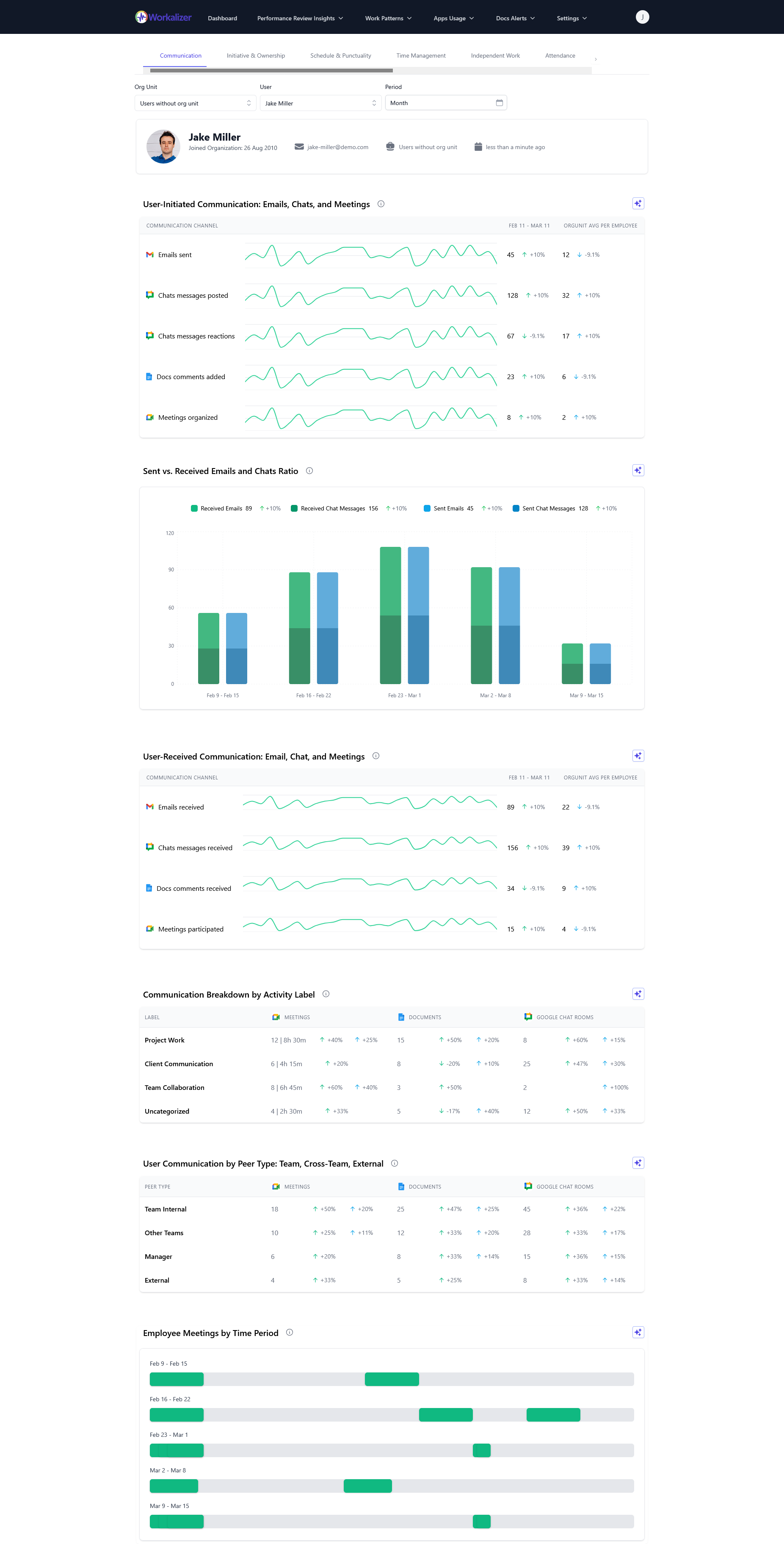
Workalizer offers a unique approach to performance reviews, moving beyond subjective opinions to quantifiable data. Imagine being able to see:
- Communication Patterns: Who are the key collaborators? Are employees effectively using communication tools like Gmail and Chat?
- Document Activity: How often are employees creating, editing, and share documents on Google? Are they actively contributing to shared projects?
- Meeting Effectiveness: Are meetings productive and focused, or are they a drain on time?
- AI Tool Adoption: Are employees leveraging tools like Gemini to enhance their productivity and creativity?
This data is anonymized and aggregated to protect employee privacy, focusing on overall team and individual productivity trends rather than individual actions. This allows for constructive feedback and targeted training opportunities.
Case Study: Boosting Engineering Team Efficiency by 15%
One of our clients, a mid-sized software company, was struggling with project delays and low morale within their engineering team. Traditional performance reviews weren't providing any actionable insights. After implementing Workalizer, they discovered that a significant portion of the team's time was being spent in unproductive meetings and resolving communication silos. By streamlining meeting schedules, improving internal communication workflows, and providing training on effective collaboration tools, they saw a 15% increase in team efficiency within just three months. This translated into faster project completion times and a significant boost in team morale.
Addressing the Challenges of AI Adoption
While AI offers tremendous potential for improving performance reviews, it's important to address potential challenges. Concerns about data privacy, algorithmic bias, and the potential for misuse must be taken seriously. Workalizer is committed to ethical AI practices, including:
- Data Anonymization: Protecting employee privacy is our top priority. All data is anonymized and aggregated to prevent individual identification.
- Algorithmic Transparency: We are committed to transparency in our algorithms and data analysis methods.
- Human Oversight: AI should augment, not replace, human judgment. Managers still play a critical role in interpreting data and providing personalized feedback.
The Future of Performance Reviews is Data-Driven
The days of subjective, biased performance reviews are numbered. In 2026, companies that embrace AI-driven productivity insights will have a significant competitive advantage. They'll be able to:
- Identify and reward top performers: Objectively recognize employees who are making the biggest impact.
- Uncover hidden inefficiencies: Identify bottlenecks and areas for improvement in workflows and processes.
- Provide targeted training and development: Focus training efforts on areas where employees need the most support.
- Improve employee engagement and retention: Create a fairer and more transparent work environment that fosters trust and loyalty.
Benchmarking Your Productivity: Are You Falling Behind?
According to a recent industry report, companies that have adopted AI-powered performance review systems have seen an average of 12% increase in employee productivity and a 10% reduction in employee turnover. Are you ready to join the revolution?
Consider how performance reviews are evolving in 2026 and how Workalizer can help your company remain competitive.
Navigating the Ethical Landscape of AI in HR
The integration of AI in HR, particularly in performance reviews, demands careful consideration of ethical implications. Caitlin Kalinowski's recent resignation from OpenAI, citing concerns about "lethal autonomy without human authorization," underscores the importance of ethical deliberation in AI development. While her concerns relate to robotics, the principle applies equally to HR tech: AI should augment human decision-making, not replace it entirely. Ensuring fairness, transparency, and accountability is paramount to building trust and avoiding unintended consequences.
Furthermore, as OpenAI reportedly delays its 'adult mode' (Engadget), it highlights the ongoing need for responsible AI development and deployment. Companies must prioritize user safety and ethical considerations, especially when dealing with sensitive data.
For example, when needing to how to share files with google, employees must be aware of the security and privacy implications of sharing sensitive company data. Workalizer helps companies monitor and manage file sharing activity to prevent data breaches and ensure compliance with data privacy regulations.
Getting Started with Workalizer
Ready to transform your performance review process? Workalizer offers a free trial, allowing you to experience the power of AI-driven productivity insights firsthand. Contact us today to learn how we can help you build a fairer, more effective, and more productive workforce. We'll show you essential fixes for Google Workspace AI activity.
By embracing AI, companies can unlock the full potential of their workforce and create a more equitable and rewarding work environment.