Is AI Truly Driving Efficiency, Or Just Disguising a Workforce Reckoning?
The headlines from April 2026 paint a stark, almost contradictory picture. On one hand, we see unprecedented investment in artificial intelligence, promising a golden age of efficiency and innovation. On the other, we witness significant workforce reductions, often justified by the very same AI advancements. It begs the question: Is AI truly driving a new era of productivity, or is it merely providing cover for a deeper, more unsettling transformation of the modern workforce?
At Workalizer.com, we believe that understanding this shift requires more than just rhetoric; it demands data-driven insights into how AI is actually impacting human performance and collaboration within platforms like Google Workspace. Let’s cut through the noise and examine the uncomfortable truths emerging in the enterprise world.
The AI Paradox: Investing Billions, Shedding Thousands
Consider Meta. Just yesterday, on April 23, 2026, the company announced it would cut approximately 8,000 employees, about 10% of its global workforce, starting May 20th. This isn't a one-off; an additional 6,000 open roles have been cancelled, with more cuts anticipated for the second half of this year. The kicker? Survivors are reportedly being asked to train their AI replacements. This dramatic restructuring, as reported by The Next Web, comes as Meta plans to spend an astonishing $115-135 billion on AI infrastructure in 2026 alone – a 73% increase over 2025.
This isn't an isolated incident. The race for AI dominance is fueling a speculative frenzy, exemplified by SoftBank's aggressive financial maneuvers. The Japanese conglomerate is seeking a $10 billion margin loan backed by its OpenAI shares, on top of a $40 billion bridge loan secured in March 2026. This brings SoftBank’s total OpenAI commitment to an astounding $64.6 billion. While their stake in OpenAI is notionally worth around $110 billion at an $852 billion valuation, the deeply leveraged position has already led S&P to downgrade SoftBank’s outlook to negative. It’s a high-stakes gamble on AI's promise, but one that comes with significant financial and human costs.
For HR leaders and C-suite executives, these numbers aren't just abstract figures; they represent a fundamental re-evaluation of human capital and operational expenditure. The message is clear: companies are betting big on AI to drive efficiency, even if it means a leaner, more technologically integrated workforce. The question isn't whether AI will transform your organization, but how you will manage that transformation ethically, effectively, and with clear performance metrics.
The New AI Battleground: Performance, IP, and the Enterprise Edge
The Race for AI Supremacy: GPT-5.5 vs. Claude
The enterprise AI landscape is fiercely competitive, with major players vying for market dominance. OpenAI just launched GPT-5.5, codenamed “Spud,” its first fully retrained base model since GPT-4.5. This model is designed for a new level of autonomy, capable of completing complex multi-step tasks with minimal human direction, operating across email, spreadsheets, and calendars. OpenAI touts its 'legibility,' meaning it can take a 'messy, multi-part task' and independently plan, use tools, check its work, and navigate ambiguity.
These capabilities, especially in agentic coding, computer use, and knowledge work, are a direct response to Anthropic's rapid ascent. Anthropic’s Claude has been winning the enterprise market, with its Annual Recurring Revenue (ARR) sprinting from $9 billion to $30 billion while OpenAI was reportedly in a 'Code Red' state. The implications for Google Workspace teams are profound: advanced AI models are no longer just assistants; they are becoming increasingly capable agents, ready to take on more complex workflows. This shift demands that organizations not only adopt these tools but also understand how to effectively integrate them into their existing ecosystems. For insights into how AI is already reshaping content creation, you might find our post on Supercharge Your Content Strategy: How Google Workspace Teams Leverage an AI Content Generation Platform particularly relevant.
Protecting Your Intellectual Property in the AI Era
As AI models become more sophisticated, the issue of intellectual property (IP) protection has become a critical concern. The White House recently accused China of “industrial-scale” distillation of US AI models, a technique that involves feeding thousands of queries to a frontier AI model to train a cheaper rival. This isn't theoretical: OpenAI accused DeepSeek of distilling its models in February 2026, and Anthropic named DeepSeek, MiniMax, and Moonshot AI as having created 24,000 fraudulent accounts that generated over 16 million exchanges with Claude.
This alarming trend highlights a significant vulnerability for enterprises. Your proprietary data, your unique insights, and your competitive edge are at risk if not properly secured. The rise of 'AI slop' – low-quality, AI-generated content – further complicates the landscape, as Google’s Liz Reid recently discussed regarding AI search changes and query shifts. For organizations that frequently google drive share files with others containing sensitive information or original research, robust data governance and secure sharing protocols are no longer optional; they are paramount. Ensuring that your teams understand how to share drive file securely and responsibly is more critical than ever.
Redefining Productivity: Beyond Just 'Doing More'
If AI is automating tasks at an unprecedented rate, what does 'productivity' even mean for the human workforce in 2026? It's no longer just about completing more tasks faster. Instead, the focus shifts to higher-order thinking: strategic planning, creative problem-solving, emotional intelligence, and leveraging AI tools to amplify human capabilities. The value proposition of human talent is evolving from transactional execution to strategic oversight and innovation.
For HR leaders and engineering managers, this means re-evaluating traditional performance metrics. How do you measure the impact of an employee who effectively directs an AI agent to perform complex analyses, rather than performing the analysis themselves? The answer lies in understanding the qualitative aspects of work, the strategic contributions, and the efficiency gains derived from AI integration, not just the raw output. Tools that streamline basic workflows, like ensuring optimal user experience, become even more vital. If your teams are experiencing hiccups with core tools, even seemingly minor issues like those addressed in Stuck in the Past? Restoring Your Gemini UI for Optimal Google Workspace Performance, can cumulatively impact this new definition of productivity.
Google Workspace, as a central nervous system for many organizations, is at the heart of this transformation. The way teams collaborate, create, and communicate within this ecosystem is being fundamentally reshaped by AI. Understanding and optimizing these interactions is key to thriving in the AI-driven enterprise.
The Workalizer Edge: Unbiased Insights for the AI-Driven Enterprise
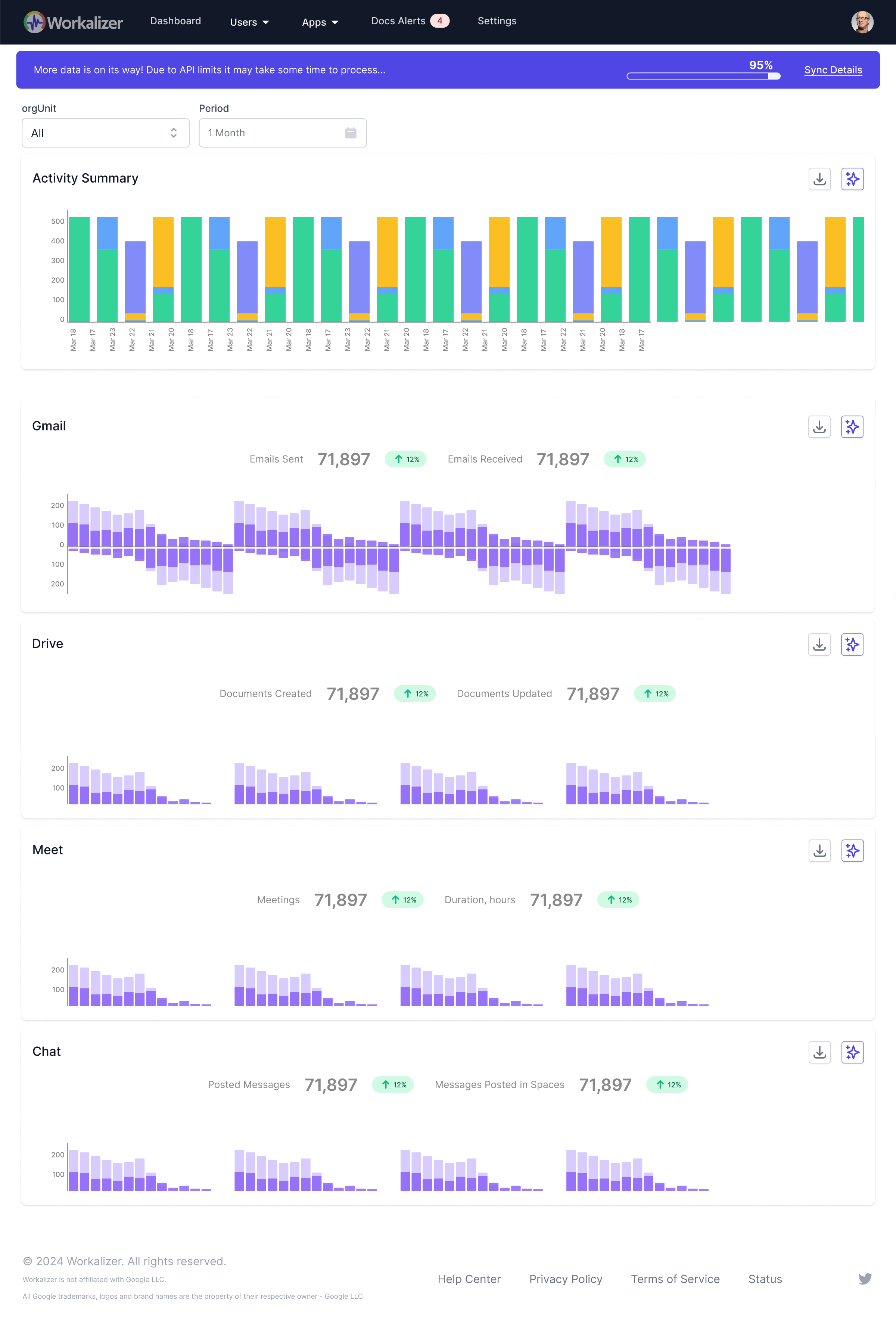
Navigating this complex landscape requires clarity and unbiased data. At Workalizer.com, we provide AI-powered performance review insights based on your company's Google Workspace usage. We analyze signals from Gmail, Drive, Chat, Gemini, and Meet to deliver data-driven, unbiased productivity analytics that reveal the true impact of AI on your workforce.
We help HR leaders understand shifts in collaboration patterns, enable engineering managers to identify workflow bottlenecks, and empower C-suite executives to make strategic decisions based on real-world usage data. In an era where AI promises efficiency but delivers uncertainty, Workalizer offers the objective lens you need to understand, adapt, and lead.
The AI revolution is here, and it’s reshaping the very fabric of work. The question is not whether to embrace it, but how to do so intelligently, ethically, and with a clear understanding of its true impact on your most valuable asset: your people. Don't let the hype or the fear dictate your strategy. Let data guide you.