Defying Predictions: How AI is Supercharging Workplace Productivity (and App Growth) in 2026
Defying Predictions: How AI is Supercharging Workplace Productivity (and App Growth) in 2026
Everyone said AI would kill apps. They said it would dismantle SaaS as we know it, rendering traditional enterprise software obsolete. They whispered of a future where human roles dwindled, replaced by an army of algorithms and robots. Well, it's April 20, 2026, and I'm here to tell you that the rumors of AI's destructive power have been, as Mark Twain might say, greatly exaggerated. What we're witnessing instead is a profound augmentation – a supercharging of human potential and, surprisingly, a boom in the very ecosystems many predicted would fall.
The App Economy's Unexpected Resurgence
Let's start with the App Store. The prevailing theory was that AI chatbots and agents would divert user attention away from individual apps. Yet, the data tells a radically different story. According to a recent analysis by market intelligence provider Appfigures, worldwide app releases in Q1 2026 were up a staggering 60% year-over-year across both Apple's App Store and Google Play. On iOS alone, that figure jumped to 80%. Even more dramatically, in April 2026 so far, total app releases are up 104% across both stores compared to last year, and 89% on iOS. As Apple's Senior Vice President of Worldwide Marketing, Greg Joswiak, recently quipped, 'rumors of the App Store’s death in the AI age may have been greatly exaggerated.' (Source: TechCrunch). This isn't just about new games; it's about a surge in specialized AI-powered tools, productivity enhancers, and niche applications that leverage AI to solve specific problems. For HR leaders and C-suite executives, this means an explosion of new solutions designed to streamline workflows, enhance decision-making, and unlock new levels of efficiency within their organizations.
SaaS Isn't Dead; It's Evolving for the AI Era
The 'SaaS is dead' narrative gained significant traction, especially after Klarna's CEO, Sebastian Siemiatkowski, mentioned in August 2024 that the fintech giant had 'shut down Salesforce' to build its own AI-driven replacements. This sent shockwaves through the industry, with many predicting the demise of traditional enterprise software. But the reality is far more nuanced. SaaS is not dead; it's adapting. The companies that will thrive in the next five years are those that understand that AI isn't an 'either/or' proposition but a powerful 'and.' While custom AI solutions like Klarna's (and rumored Workday replacements) offer tantalizing possibilities for hyper-optimization, the majority of enterprises will continue to rely on robust SaaS platforms that are rapidly integrating AI capabilities. The shift isn't away from SaaS, but towards smarter, more integrated SaaS that leverages AI to deliver unprecedented value. It's about platforms becoming more intelligent, not obsolete. This evolution demands that organizations stay agile, constantly evaluating their tech stack to ensure it supports, rather than hinders, their AI ambitions. For a broader look at how technology is shaping our working lives, you might find our recent post, 5 Unavoidable Tech Shifts Redefining Workforce Productivity in 2026, particularly insightful.
Augmenting the Workforce: From Executives to Factory Floors
The most compelling aspect of AI's current trajectory is its role in augmenting human capabilities across the board. We're seeing this at the very top, with tech CEOs exploring AI doubles. Meta, for instance, is reportedly developing a photorealistic, three-dimensional AI avatar of Mark Zuckerberg, trained on his public comments and corporate strategy. This 'Zuckerbot' is designed to interact with Meta staff, answer questions, and offer managerial guidance (Source: WIRED). This isn't just a novelty; it signals a future where executive presence can be scaled, allowing leaders to 'be everywhere at once' without sacrificing personal bandwidth.
Beyond the C-suite, AI is transforming operational roles. Siemens, in partnership with Nvidia and UK robotics startup Humanoid, recently deployed an AI-powered wheeled humanoid robot, the HMND 01 Alpha, in live logistics operations at its Erlangen factory in Germany. This robot successfully completed over eight hours of autonomous tote-handling at 60 moves per hour with a pick-and-place success rate above 90% (Source: The Next Web). This wasn't a lab experiment; it was real-world integration, tackling repetitive, physically demanding tasks and coordinating with human operators. This demonstrates AI's capacity to free up human workers for more complex, creative, and value-added activities, directly impacting an organization's bottom line and employee satisfaction.
The Critical Role of Data Flow and Collaboration in an AI-Augmented World
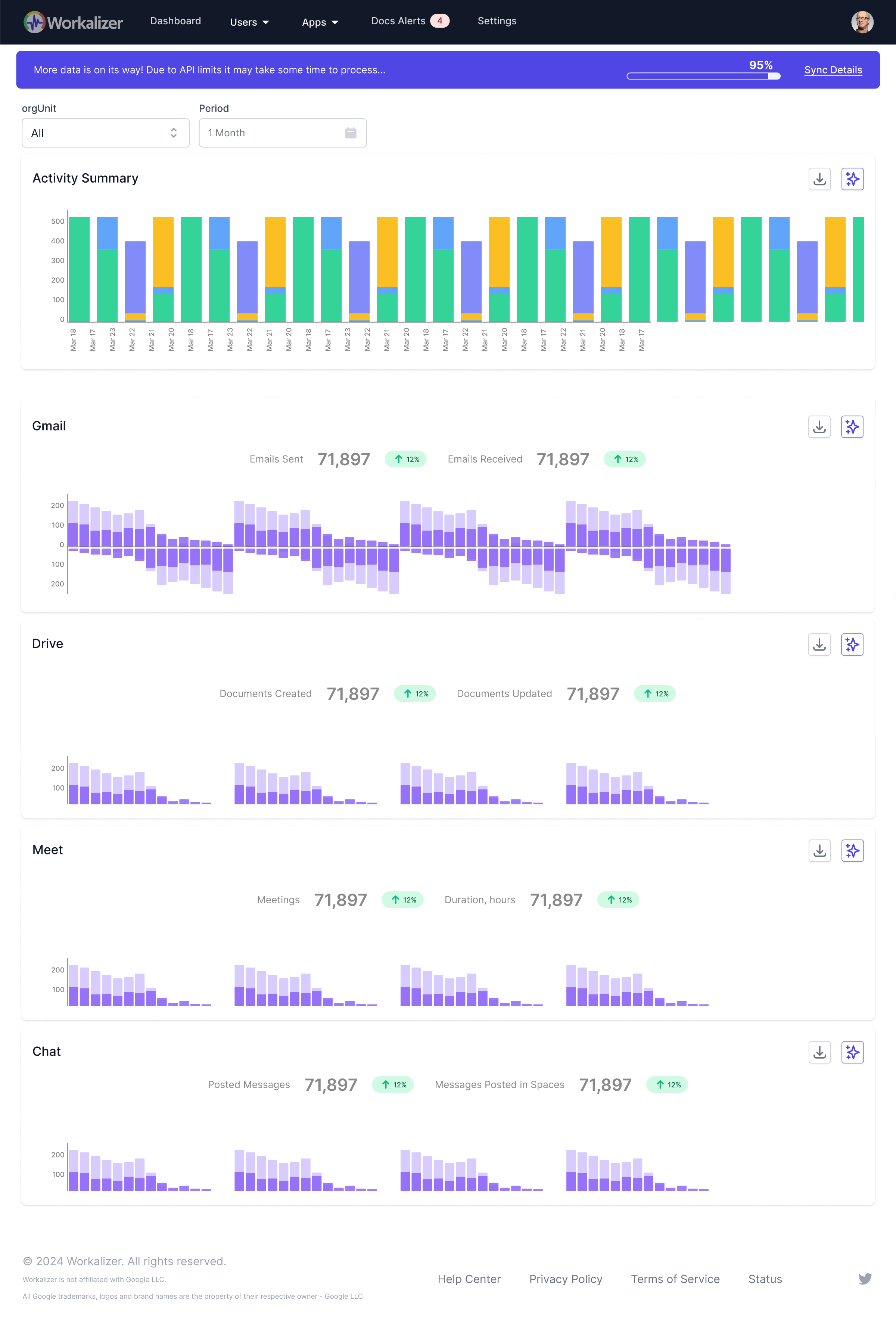
As AI becomes deeply embedded in every facet of our operations, the efficiency of information flow and collaboration becomes paramount. If AI is the engine, then well-managed data and seamless communication are the fuel and the tracks. Workalizer understands this intimately. Our platform analyzes signals from Google Workspace – Gmail, Drive, Chat, Gemini, Meet – to provide data-driven, unbiased productivity analytics. In an AI-augmented environment, understanding how your teams are collaborating with and leveraging these new tools is more critical than ever.
Consider the simple yet profound act of sharing information. Whether it's a project brief, an analytics report, or a strategic document, knowing how to share a file via Google Drive efficiently and securely is foundational. With AI generating insights, drafting content, or even managing tasks, the need for robust Google document sharing options that ensure the right information reaches the right people at the right time – and with the correct permissions – cannot be overstated. This is where the underlying infrastructure of Google Workspace shines. Without clear, trackable, and efficient sharing protocols, even the most advanced AI tools can create data silos and communication breakdowns. Workalizer helps you identify these bottlenecks, ensuring your organization's digital nervous system is healthy and optimized for AI integration. Speaking of Google's AI, we've even explored the nuances of its tools, such as in our article Fixing Gemini Mobile Image Editing: When Tools Disappear and Errors Emerge, highlighting the importance of understanding and managing these evolving platforms.
Navigating the New Frontier: Regulation and Responsible AI Adoption
Of course, this rapid advancement isn't without its challenges. The power of frontier AI models is attracting significant regulatory attention, particularly in sensitive sectors. Just this week, the Australian Securities and Investments Commission (ASIC) confirmed it is monitoring Anthropic's advanced Mythos AI model, alongside global regulators like the Bank of England and the US Federal Reserve (Source: The Next Web). Mythos, launched under a restricted access program, reportedly identified zero-day vulnerabilities in major operating systems and web browsers – a capability intended for defensive security but flagged as a potential systemic risk if misused.
For HR leaders and executives, this means a dual responsibility: embracing AI's transformative potential while rigorously adhering to ethical guidelines, data privacy, and regulatory compliance. The future of work isn't just about efficiency; it's about responsible efficiency. Organizations must prioritize robust governance frameworks and transparent AI policies to build trust and mitigate risks.
Conclusion: Workalizer – Your Partner in the AI-Augmented Enterprise
The narrative around AI is shifting from fear to fascination, from replacement to augmentation. In 2026, AI is not killing our apps or our jobs; it's supercharging them, opening new avenues for productivity, creativity, and strategic advantage. For HR leaders, Engineering Managers, and C-Suite Executives, the imperative is clear: understand these shifts, invest in the right tools, and cultivate a culture that embraces intelligent augmentation. Workalizer stands at the forefront of this transformation, providing the unbiased, data-driven insights you need to measure the true impact of AI on your Google Workspace environment and ensure your workforce is not just keeping pace, but leading the charge into the AI-augmented future. Don't just implement AI; optimize its impact with Workalizer.