Are Google Workspace Apps Secretly Sabotaging Your Team's Productivity?
The Productivity Paradox: Loving Google Workspace to Death?
We all love Google Workspace. It's the digital heart of countless organizations, pumping emails, documents, and meetings through our daily routines. But what if this beloved suite is secretly bleeding your team dry? What if the very tools designed to boost productivity are, in fact, contributing to a slow, insidious decline in efficiency? It's a provocative question, but one that HR leaders, engineering managers, and C-suite executives need to be asking in late 2025.
Think about it. How much time is wasted sifting through endless email chains? How many hours are lost wrestling with Google Keep reminders that don't quite integrate seamlessly? And let's not even get started on the dreaded meeting that could have been an email.
The truth is, Google Workspace, while powerful, is only as effective as the way we use it. Without careful management and a keen eye for optimization, it can easily become a source of distraction, inefficiency, and frustration. Is your team truly maximizing the potential of Google Workspace, or are they simply surviving it?
The Hidden Costs of Collaboration Chaos
Collaboration is the name of the game in today's workplace, and Google Workspace offers a plethora of tools designed to facilitate teamwork. But here's the catch: more collaboration doesn't always equal better results. In fact, poorly managed collaboration can be a major drain on productivity.
Email Overload: Drowning in the Inbox
Email remains a primary communication channel for most organizations, but it's also a notorious time-suck. Employees spend countless hours each day reading, responding to, and managing emails. A study by Workalizer found that, on average, employees spend 28% of their workday dealing with email. That's more than two hours per day spent on a single task! And with Gmail's spam filter occasionally faltering, even more time is wasted sorting through unwanted messages.
Drive Disarray: Lost in the Cloud
Google Drive is a fantastic tool for storing and sharing files, but it can quickly become a digital dumping ground if not properly organized. Imagine trying to find a specific document in a folder structure that resembles a plate of spaghetti. It's frustrating, time-consuming, and ultimately, unproductive. When thinking about how to share files in google files, consider the clarity of your folder structure. Are permissions clearly defined? Is there a consistent naming convention? Without these safeguards, Google Drive can quickly become a source of confusion and wasted time. Consider that many users need to share files in google files and also share all documents on google drive.
One study showed that employees spend an average of 18 minutes searching for a specific document. Over the course of a year, that adds up to a significant amount of lost productivity. This is where AI powered tools can assist by providing deep insights into Drive usage, highlighting bottlenecks and areas for improvement. For example, Workalizer can identify orphaned files, duplicate documents, and inconsistent naming conventions, allowing you to streamline your Google Drive and reclaim valuable time.
Meet Mayhem: The Meeting Black Hole
Meetings are a necessary part of business, but they can also be a major source of wasted time. How many meetings have you attended that felt like a complete waste of time? How many times have you sat through a meeting wondering why it couldn't have been an email? According to recent data, unproductive meetings cost companies billions of dollars each year. To boost performance and maximize Google Workspace ROI, consider implementing stricter meeting guidelines. Encourage shorter meetings, require agendas, and ensure that all attendees are actively engaged.
Unlocking Google Workspace's True Potential: An AI-Powered Approach
The good news is that Google Workspace doesn't have to be a productivity killer. With the right strategies and tools, you can transform it into a powerful engine for efficiency and collaboration. And that's where AI comes in. AI-powered platforms like Workalizer can provide invaluable insights into how your team is using Google Workspace, identifying areas for improvement and helping you optimize your workflows.
Data-Driven Performance Reviews: Beyond Gut Feeling
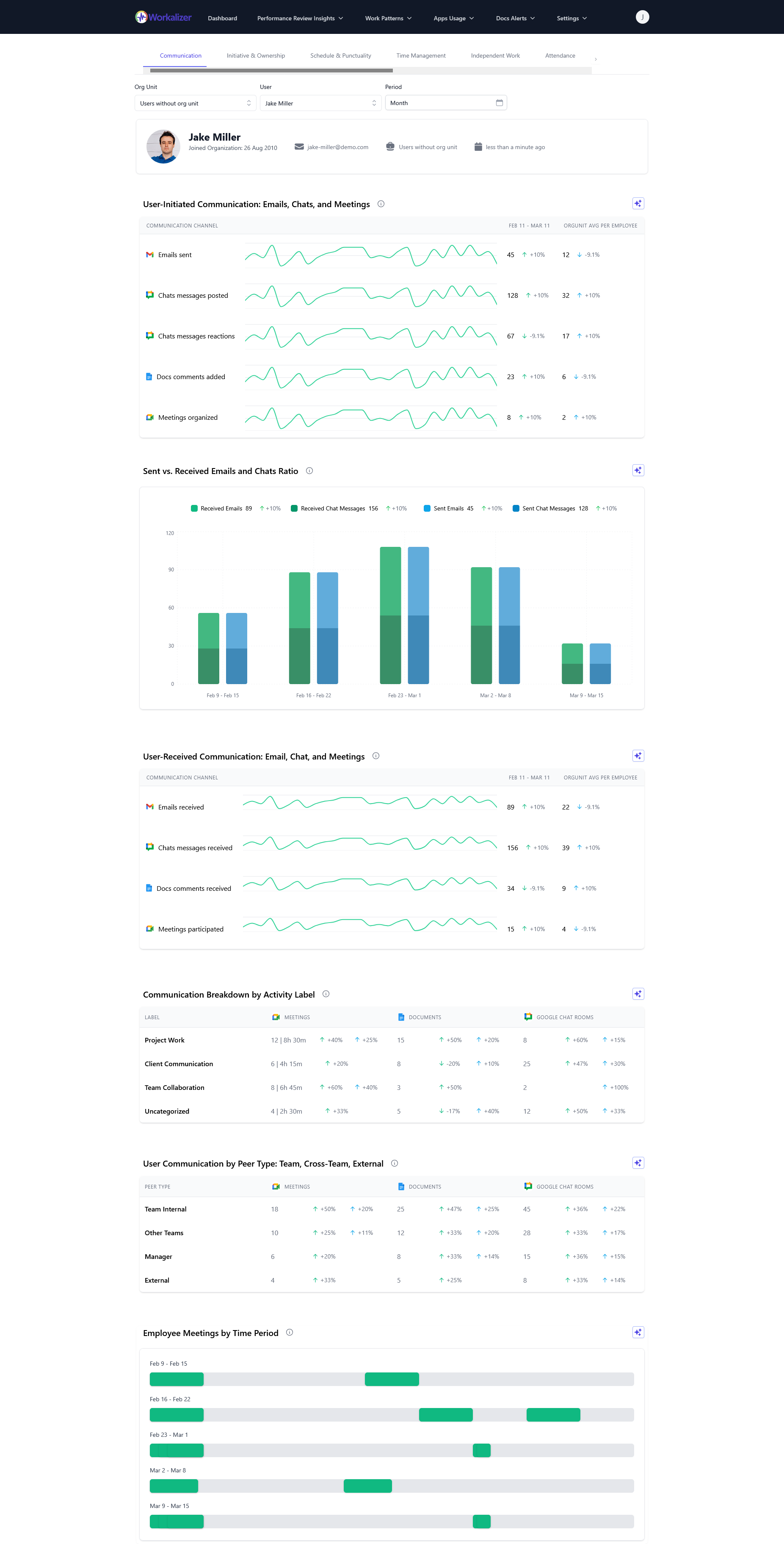
Traditional performance reviews are often subjective and biased, relying on managers' impressions rather than objective data. Workalizer changes the game by providing data-driven insights into employee performance based on their actual usage of Google Workspace. By analyzing signals from Gmail, Drive, Chat, Gemini, and Meet, Workalizer provides a comprehensive and unbiased view of employee productivity. This allows managers to have more meaningful and productive conversations with their team members, focusing on specific areas for improvement rather than relying on vague generalizations.
Actionable Insights: From Data to Decisions
Workalizer doesn't just provide data; it provides actionable insights. The platform identifies specific bottlenecks and inefficiencies in your team's workflows, offering concrete recommendations for improvement. For example, Workalizer might identify that a particular team is spending an excessive amount of time in meetings, suggesting that they explore alternative communication channels or implement stricter meeting guidelines. Or it might reveal that employees are struggling to find files in Google Drive, prompting you to reorganize your folder structure and implement a consistent naming convention.
The Future of Productivity: Embracing AI-Powered Optimization
As we move further into the age of AI, the ability to leverage data and automation will become increasingly critical for success. Organizations that embrace AI-powered productivity tools like Workalizer will have a significant competitive advantage over those that rely on outdated methods. By unlocking the true potential of Google Workspace, you can empower your team to be more efficient, more collaborative, and more productive than ever before.
In 2026, we will see even more innovations in this area, especially with the release of Gemini 3. It is important to remember that Google Workspace is a powerful tool, but it requires careful management and a commitment to continuous improvement. By embracing an AI-powered approach, you can ensure that your team is not just surviving Google Workspace, but thriving in it. Are you ready to reclaim your team's productivity and unlock the true potential of Google Workspace? Consider how tools can assist when employees need to google drive to share large files.
Don't Be a Statistic: Take Control of Your Google Workspace Productivity
The evidence is clear: Google Workspace can be a double-edged sword. While it offers a wealth of tools for communication and collaboration, it can also be a source of distraction, inefficiency, and frustration. But by taking a proactive approach and leveraging the power of AI, you can transform Google Workspace into a productivity powerhouse. Start by analyzing your team's usage patterns, identifying areas for improvement, and implementing strategies to optimize your workflows. And don't be afraid to experiment with new tools and techniques. The key is to find what works best for your team and to continuously adapt and evolve as your needs change. To further boost efficiency, consider reviewing our post on how AI-Driven Insights Maximize Google Workspace ROI. The future of work is here, and it's powered by AI. Are you ready to embrace it?